Latest Post

Blogs

ChatGPT Image Sep 29, 2026, 03_41_26 PM (1)

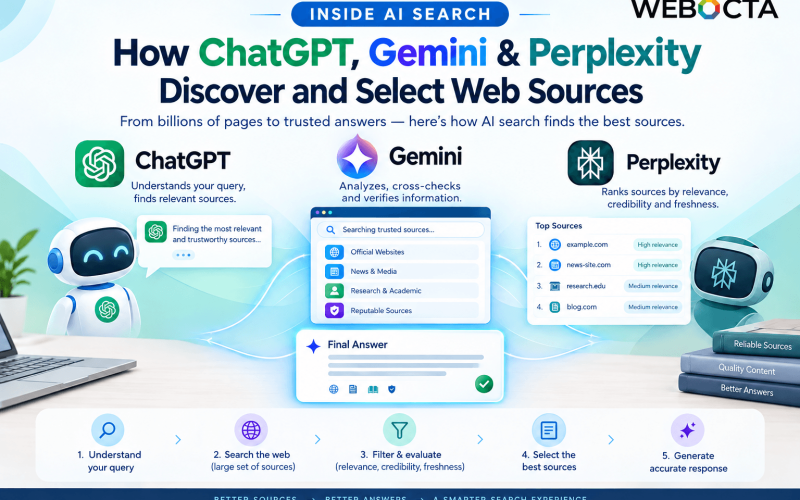
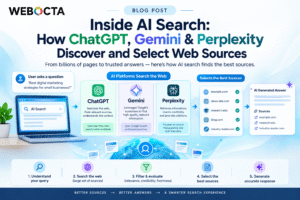
Inside AI Search: How ChatGPT, Gemini & Perplexity Discover and Select Web Sources

Search is changing rapidly. For years, businesses focused on ranking their websites on Google and other traditional search engines. Today, users are increasingly asking AI tools such as ChatGPT, Google Gemini, and Perplexity to research products, compare services, answer questions, and summarize information.

This creates a new question for businesses: How do AI search platforms discover and select the web sources they use in their answers?

Understanding this process can help marketers create content that is easier for AI systems to discover, understand, and potentially reference.

What Is AI Search?

AI search combines traditional information retrieval with artificial intelligence. Instead of simply presenting a list of links, AI-powered platforms can interpret a user’s question, retrieve relevant information, and generate a conversational response.

Different platforms use different technologies and workflows. Some AI experiences can search the web in real time, while others may use information from their underlying models, connected sources, or specialized retrieval systems.

This means there is no single universal “AI ranking algorithm.”

However, several common principles influence whether online information can be discovered and used.

How Does ChatGPT Discover Web Sources?

When web search is available, ChatGPT can search the internet to find information relevant to a user’s question. It may retrieve multiple webpages, evaluate the available information, and use relevant sources when generating its response.

For businesses, this means having a website that clearly explains what the company does, who it serves, and what information it provides can be important.

Content should be:

  • Clear and easy to understand
  • Relevant to specific user questions
  • Well structured
  • Factually accurate
  • Supported by trustworthy information
  • Regularly maintained when information changes

A page that directly answers a user’s question can be more useful than a page created primarily to repeat keywords.

How Does Google Gemini Find Information?

Google Gemini is integrated into Google’s broader ecosystem, and its search-related experiences can use information retrieved from the web.

Google’s search systems have long emphasized relevance, quality, usefulness, and technical accessibility. These principles remain important when creating content that may appear in AI-powered search experiences.

For example, a business publishing a detailed guide about local SEO should clearly explain concepts, use descriptive headings, answer common questions, and provide information that users can actually apply.

AI systems can then have clearer information to interpret when retrieving content.

How Does Perplexity Select Sources?

Perplexity is designed around an answer-focused search experience. It retrieves information from online sources and typically provides citations so users can examine where information came from.

This makes source quality particularly important.

If your website publishes original research, expert insights, statistics, case studies, or detailed educational content, those resources can potentially become useful references when an AI search system is researching a related topic.

However, appearing as a source is never guaranteed. AI systems can choose different sources depending on the user’s exact question, available information, freshness, relevance, and other factors.
What Makes a Website More Discoverable to AI Search?

Although AI platforms differ, several SEO fundamentals remain useful.

1. Create Helpful, Original Content

AI systems need information they can understand and use. Instead of producing large volumes of generic articles, focus on creating original, useful resources.

Include practical examples, explanations, statistics, case studies, and expert perspectives where appropriate.

2. Answer Specific Questions

Users increasingly ask detailed questions rather than searching for short keywords.

For example, instead of targeting only “SEO services,” create useful content around questions such as:

“How does local SEO help small businesses generate leads?”

Answer the question directly and provide supporting information throughout the article.

3. Build Topical Authority

A single article may not establish your expertise on an entire subject.

A digital marketing company, for example, could create connected content covering technical SEO, on-page SEO, local SEO, content marketing, keyword research, analytics, and AI search.

Internal links can help users and search engines understand the relationship between these topics.

4. Keep Information Accurate and Updated

AI search often deals with questions where information can change quickly.

Business details, product information, statistics, regulations, pricing, and technology developments should therefore be reviewed and updated when necessary.

Outdated information can reduce the usefulness of a page.

5. Make Your Website Easy to Understand

Technical SEO still matters.

Search engines and other systems need to access your website effectively. Make sure important pages are crawlable, mobile-friendly, reasonably fast, and logically structured.

Use descriptive page titles, headings, URLs, image alt text, and appropriate structured data where relevant.

6. Establish Trust and Credibility

Who created the content? What experience or expertise do they have? Is the information supported by reliable evidence?

Clearly identifying authors, businesses, sources, and relevant credentials can help users understand why they should trust the information.

AI Search Is Not a Replacement for SEO

One common misconception is that businesses now need to choose between SEO and AI optimization.

In reality, many of the fundamentals overlap.

High-quality content, strong technical foundations, clear website architecture, relevant topics, authoritative references, and a positive user experience remain valuable.

The difference is that marketers now need to think beyond traditional search-result rankings and consider how their content can become useful information within AI-generated answers.

How Businesses Can Prepare for AI Search

Businesses should begin by auditing their existing content.

Identify the questions your customers ask, then determine whether your website provides clear and authoritative answers. Update outdated articles, strengthen weak content, create original resources, and improve internal linking.

It is also useful to monitor how your brand appears across different AI search platforms. Because AI-generated results can vary based on the question, location, time, available sources, and other factors, a single observation should not be treated as a permanent ranking.

Conclusion

AI search is changing how people discover information online. ChatGPT, Gemini, and Perplexity can use different systems and sources, but businesses can improve their chances of being discoverable by focusing on the fundamentals: useful content, technical accessibility, clear information, topical expertise, accuracy, and credibility.

The future of search is not simply about ranking a webpage. It is increasingly about becoming a reliable source of information that search engines and AI systems can understand, retrieve, and potentially reference.

For digital marketers, this creates a broader opportunity: instead of optimizing content only for keywords, create resources that genuinely answer the questions your audience is asking.
ChatGPT Image Sep 16, 2026, 10_54_23 AM

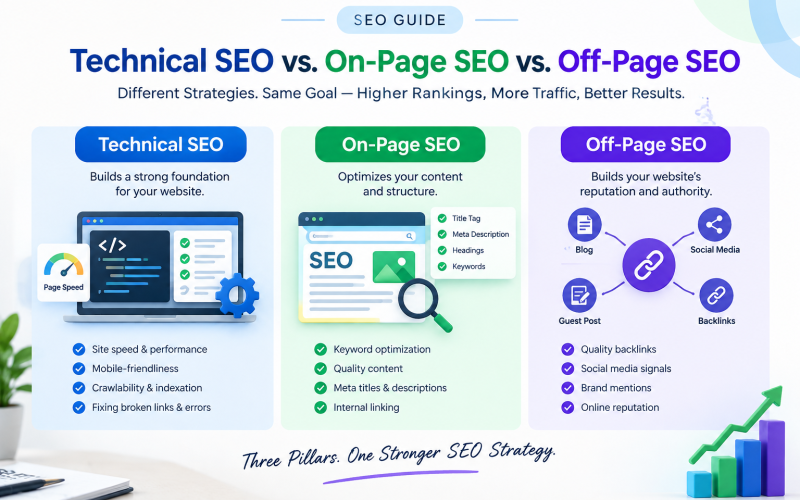
Technical SEO vs. On-Page SEO vs. Off-Page SEO

Search Engine Optimization (SEO) is one of the most important digital marketing strategies for businesses that want to improve their online visibility. However, SEO is not just about adding keywords to a website. A successful SEO strategy involves several different elements, including Technical SEO, On-Page SEO, and Off-Page SEO.

Although all three work toward the same goal—improving search engine visibility—they focus on different areas of your website and online presence. Understanding the difference can help businesses build a stronger SEO strategy and attract more relevant visitors.

What Is Technical SEO?

Technical SEO focuses on improving the technical foundation of your website so that search engines can crawl, understand, and index your pages effectively.

Technical SEO does not primarily deal with the content visitors read. Instead, it focuses on how well your website functions behind the scenes.

Important areas of Technical SEO include:

  • Website loading speed and performance
  • Mobile-friendliness
  • Website security and HTTPS
  • XML sitemap optimization
  • Robots.txt configuration
  • Crawlability and indexability
  • Fixing broken links and errors
  • Proper website architecture
  • Structured data and schema markup
  • Core Web Vitals

For example, if your website contains excellent content but loads very slowly on mobile devices, visitors may leave quickly. Technical improvements can create a better experience for users while also making it easier for search engines to access your website.

What Is On-Page SEO?

On-Page SEO refers to optimizing the content and elements that appear directly on your website. The purpose is to help search engines understand what each page is about while providing useful information to visitors.

Some important On-Page SEO factors include:

  • Keyword research and keyword placement
  • SEO-friendly title tags
  • Meta descriptions
  • Heading structure
  • High-quality and original content
  • Internal linking
  • Image optimization and alt text
  • URL structure
  • Search intent optimization

For example, if you operate a digital marketing company and create a page targeting the keyword “digital marketing services,” the page should provide useful information about those services. The primary keyword can be naturally incorporated into the title, headings, content, URL, and other relevant areas.

However, keyword usage should always feel natural. Simply repeating a keyword multiple times does not automatically make a page better. Search engines increasingly focus on helpful, relevant content that satisfies the user’s search intent.

What Is Off-Page SEO?

Off-Page SEO involves activities performed outside your website to build its authority, credibility, and online reputation.

One of the most well-known aspects of Off-Page SEO is link building. When reputable websites link to your content, those links can contribute to your website’s authority. However, quality is generally more important than simply obtaining a large number of links.

Common Off-Page SEO activities include:

  • Earning high-quality backlinks
  • Digital PR
  • Guest posting
  • Brand mentions
  • Online reputation management
  • Content promotion
  • Relevant business listings and citations
  • Social media promotion

For example, if an industry publication references your company’s research and links to your website, it can help increase your brand’s visibility and potentially strengthen your site’s authority.

Businesses should avoid manipulative link-building practices. The goal should be to earn relevant, trustworthy references rather than collecting links simply for quantity.

Technical SEO vs. On-Page SEO vs. Off-Page SEO

The easiest way to understand the difference is to think of SEO as a three-part system.

Technical SEO builds the foundation. It ensures that your website is technically accessible, fast, secure, and easy for search engines to crawl.

On-Page SEO improves what is actually on your website. It makes your content more relevant, understandable, and useful for both search engines and visitors.

Off-Page SEO builds your website’s reputation outside your own domain. It helps establish credibility through backlinks, mentions, digital PR, and other external signals.

These three areas should not be treated as completely separate strategies. They work together.

Why Do You Need All Three?

Imagine creating an attractive website with excellent content but ignoring technical problems. Search engines may have difficulty crawling or indexing important pages.

Now imagine having a technically perfect website with poor content. Visitors may not find the information they need, and the website may struggle to satisfy search intent.

Finally, consider a technically strong website with excellent content but little online authority. It may take longer to establish visibility in competitive search results.

A balanced SEO strategy addresses all three areas.

How to Create an Effective SEO Strategy

Start by performing a technical SEO audit to identify issues affecting website performance, crawlability, mobile usability, and indexing.

Next, review your website’s content. Conduct keyword research, understand your audience’s search intent, improve titles and headings, optimize internal links, and create genuinely useful content.

Finally, develop an Off-Page SEO strategy focused on earning relevant backlinks, promoting valuable content, building brand awareness, and establishing your business as a credible source within your industry.

SEO is not a one-time activity. Search algorithms, competitors, customer behavior, and your own website will continue to change. Regular monitoring and optimization are therefore essential.


Conclusion

Technical SEO, On-Page SEO, and Off-Page SEO are three essential parts of a complete SEO strategy. Technical SEO ensures that your website has a strong foundation, On-Page SEO improves the content and structure of your pages, and Off-Page SEO helps build authority and credibility.

Instead of focusing on only one area, businesses should take a balanced approach. When technical performance, valuable content, and online authority work together, your website is better positioned to attract relevant traffic, provide a positive user experience, and support long-term digital growth.

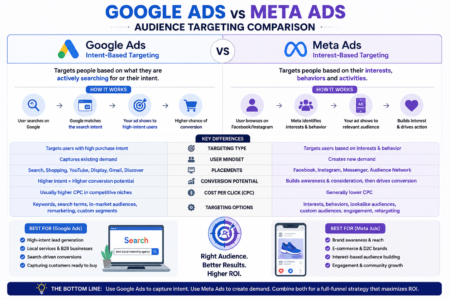
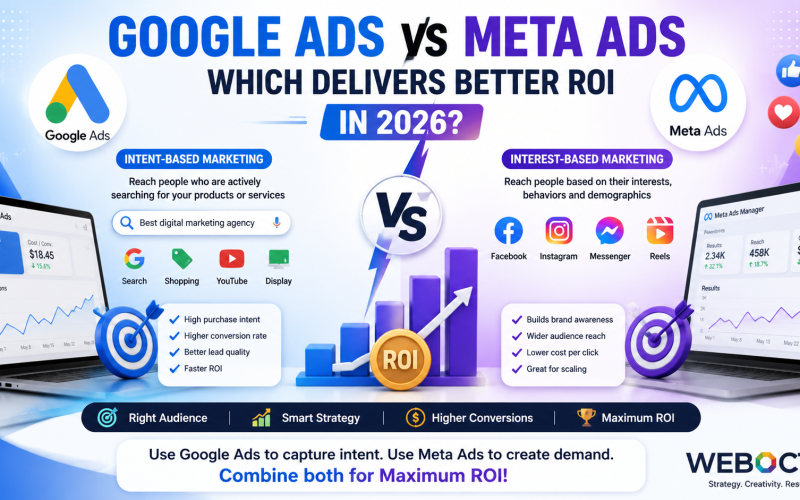
Google Ads vs Meta Ads comparison showing intent-based and interest-based advertising strategies to maximize ROI in 2026

Google Ads vs Meta Ads: Which Delivers Better ROI in 2026?

If you’re planning to invest in paid advertising, one of the biggest questions you’ll face is Google Ads vs Meta Ads: Which delivers better ROI? The answer isn’t as simple as choosing one platform over the other. Your return on investment depends on your business goals, target audience, industry, budget, and the stage of the customer journey you’re trying to influence.

Both Google Ads and Meta Ads have evolved significantly in 2026, introducing advanced AI-powered optimization, automated bidding, smarter audience targeting, and machine learning capabilities. While Google Ads captures users with high purchase intent through search, Meta Ads excel at creating demand, building brand awareness, and driving engagement across Facebook, Instagram, Messenger, and Audience Network.

After managing campaigns across multiple industries—including e-commerce, SaaS, healthcare, education, manufacturing, and service-based businesses—one insight remains consistent: the highest ROI comes from using the right platform for the right objective, not simply choosing the most popular one.

In this comprehensive guide, you’ll learn how each platform works, where each performs best, and how to maximize your advertising budget for measurable business growth.

What is Google Ads?

Google Ads is Google’s online advertising platform that enables businesses to display advertisements across:

  • Google Search
  • Google Shopping
  • YouTube
  • Gmail
  • Google Display Network
  • Google Discover
  • Google Maps
  • Partner Websites

Unlike traditional advertising, Google Ads reaches users who are actively searching for a product or service.

For example: Someone searches

“Best Digital Marketing Agency in Kolkata“

or

“Buy Running Shoes Online“

These users already have purchase intent.

This is known as Intent-Based Marketing.

Because users are already looking for solutions, Google Ads often delivers:

  • Higher conversion rates
  • Better lead quality
  • Faster sales
  • Stronger ROI for service businesses

Types of Google Ads Campaigns

Google offers multiple campaign types:

Search Campaigns

Appear directly in Google Search Results.

Best for:

  • Lawyers
  • Doctors
  • Real Estate
  • Agencies
  • SaaS
  • Local Businesses

Performance Max

Uses Google’s AI to automatically optimize ads across all Google properties.

Best for:

  • Ecommerce
  • Retail
  • Lead Generation
  • Multi-channel marketing

Shopping Ads

Perfect for ecommerce businesses selling physical products.

Display Ads

Banner advertisements appearing on millions of websites.

Ideal for:

  • Brand Awareness
  • Remarketing
  • Product Launches

YouTube Ads

Video advertisements shown before or during YouTube videos.

Excellent for:

  • Brand Building
  • Product Demonstrations
  • Educational Content

What is Meta Ads?

Meta Ads is Meta’s advertising platform that allows businesses to advertise across:

  • Facebook
  • Instagram
  • Messenger
  • Audience Network
  • Reels
  • Stories

Unlike Google, Meta focuses on Interest-Based Marketing.

Instead of waiting for users to search, Meta helps businesses discover potential customers based on their interests, online behaviors, demographics, and engagement patterns.

For example,

Someone may not search for

“Running Shoes”

But Meta knows they:

  • Follow fitness pages
  • Watch marathon videos
  • Purchase sports products
  • Engage with workout content

Meta will proactively display relevant ads before users even realize they need the product.

This demand-generation capability makes Meta one of the most effective platforms for awareness and consideration campaigns.

Types of Meta Ads

Meta offers multiple campaign objectives:

Awareness Campaigns

Increase brand visibility among new audiences.

Traffic Campaigns

Drive visitors to websites or landing pages.

Engagement Campaigns

Increase likes, comments, shares, and post interactions.

Lead Generation Campaigns

Capture customer information directly within Facebook or Instagram using instant forms.

Sales Campaigns

Optimize for:

  • Purchases
  • Add to Cart
  • Checkout
  • Conversions

App Promotion

Designed specifically for mobile application installs.

Google Ads vs Meta Ads: The Core Difference

Although both platforms help businesses acquire customers, they approach advertising in fundamentally different ways.

Feature Google Ads Meta Ads
User Intent High Medium
Marketing Type Intent-Based Intent-Based
Customer Journey Bottom Funnel Top & Middle Funnel
Purchase Readiness Very High Medium
Best For Leads & Sales Brand Awareness & Demand Generation
Search Required Yes No
AI Optimization Excellent Excellent
Comparison of Google Ads intent-based targeting and Meta Ads interest-based targeting

Think of it this way:

Google Ads

A customer says:

“I need this product right now.”

Google simply connects the customer with the best solution.

Meta Ads

Meta tells users:

“You might like this product.”

The platform creates interest before the customer actively searches.

Understanding User Intent

One of the biggest factors influencing ROI is user intent.

Imagine two people.

Person A

Searches:

“Emergency plumber near me”

This person needs immediate help.

They’re highly likely to convert.

Google Ads performs exceptionally well in this scenario because it captures users at the moment of need.

Person B

Is casually browsing Instagram.

They see an ad for a smart home device.

They weren’t planning to buy it, but the creative catches their attention.

They click, explore, and eventually make a purchase.

This is where Meta Ads shines—by creating demand through compelling visuals and precise audience targeting.

Why Intent Matters for ROI

Higher intent often means:

  • Higher conversion rates
  • Lower customer acquisition costs
  • Faster sales cycles
  • Better lead quality

However, businesses that rely on visual storytelling, impulse purchases, or brand discovery can achieve exceptional ROI with Meta Ads, especially when paired with effective retargeting.

Audience Targeting: Google Ads vs Meta Ads

One of the biggest differences between Google Ads and Meta Ads is how each platform identifies and reaches potential customers. While both offer advanced AI-powered targeting, they rely on different signals to find the right audience.

Google Ads Targeting

Google Ads primarily targets users based on search intent. It analyzes what people are actively looking for and displays ads when their queries match your keywords or audience settings.

Targeting options include:

  • Keyword Targeting
  • Location Targeting
  • Device Targeting
  • Demographic Targeting
  • In-Market Audiences
  • Custom Segments
  • Remarketing Lists
  • Customer Match
  • Performance Max AI Audience Signals

Best for:

  • Local businesses
  • B2B companies
  • Service providers
  • High-intent lead generation
  • Emergency services

Meta Ads Targeting

Meta Ads focus on discovering potential customers based on interests, online behavior, and engagement across Meta’s ecosystem.

Targeting options include:

  • Interest-Based Audiences
  • Behavioral Targeting
  • Custom Audiences
  • Lookalike Audiences
  • Website Retargeting
  • Video View Audiences
  • Instagram Engagement Audiences
  • Facebook Page Engagement
  • Advantage+ Audience

Best for:

  • E-commerce brands
  • Fashion
  • Beauty
  • Fitness
  • Lifestyle products
  • Mobile apps
  • D2C businesses

Expert Insight: While Google Ads captures existing demand, Meta Ads excel at creating new demand by introducing products to users who may not yet be searching for them.

Google Ads vs Meta Ads: Cost Comparison

Advertising costs vary by industry, competition, audience, and campaign quality. Understanding these differences can help you allocate your budget more effectively.

Metric Google Ads Meta Ads
Average CPC Higher Lower
Average CPM Moderate Lower
Lead Quality Very High High
Purchase Intent High Medium
Brand Awareness Good Excellent
Remarketing Excellent Excellent

When Google Ads Costs More

Highly competitive industries such as legal services, insurance, finance, healthcare, and software often experience higher Cost Per Click (CPC) because many advertisers compete for the same high-value keywords.

However, these clicks often produce stronger leads because users already have purchase intent.

When Meta Ads Are More Cost-Effective

Meta Ads generally provide lower costs for:

  • Brand awareness
  • Engagement
  • Video views
  • Social interaction
  • Product discovery

Businesses looking to build a large audience or introduce new products often benefit from Meta’s lower advertising costs.

ROI Comparison: Which Platform Performs Better?

The answer depends on your business goals rather than the platform itself.

Choose Google Ads If Your Goal Is:

✔ Lead Generation

✔ High-intent customers

✔ Local services

✔ Emergency services

✔ B2B marketing

✔ SaaS

✔ Healthcare

✔ Legal services

✔ Education

✔ Home services

Why?

People searching on Google are actively looking for a solution. This often leads to:

  • Higher conversion rates
  • Better lead quality
  • Faster purchasing decisions
  • Strong Return on Investment (ROI)

Choose Meta Ads If Your Goal Is:

✔ Brand Awareness

✔ E-commerce

✔ Fashion

✔ Beauty

✔ Consumer products

✔ Product launches

✔ Community building

✔ App installs

✔ Influencer campaigns

Why?

Meta excels at visual storytelling and audience discovery. Creative images, videos, and Reels can inspire purchases even before customers begin searching.

Google Ads vs Meta Ads for Different Industries 

Industry Recommended Platform
Digital Marketing Agency Google Ads
Real Estate Google Ads
Law Firms Google Ads
Hospitals & Clinics Google Ads
Local Businesses Google Ads
SaaS Google Ads
Manufacturing Google Ads
E-commerce Google Ads + Meta Ads
Fashion Meta Ads
Beauty & Cosmetics Meta Ads
Restaurants Google Ads + Meta Ads
Fitness Brands Meta Ads
Educational Institutes Google Ads + Meta Ads

Should You Use Both Platforms Together?

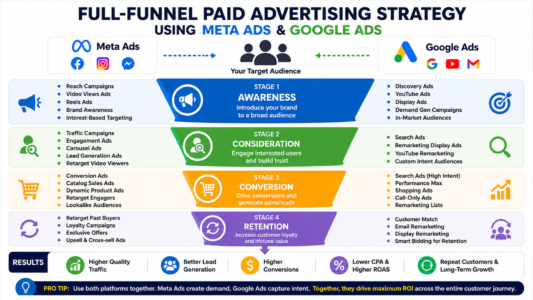
In many cases, the strongest marketing strategy is not choosing one platform over the other—it’s combining them to guide customers through the entire buying journey.

Full-funnel paid advertising strategy using Meta Ads and Google Ads

Example Funnel

Stage 1 – Awareness

Use Meta Ads to introduce your brand with engaging videos, Reels, or carousel ads.

↓

Stage 2 – Consideration

Retarget interested users with testimonials, product benefits, or educational content.

↓

Stage 3 – Conversion

Capture high-intent searches using Google Ads when prospects actively look for your product or service.

↓

Stage 4 – Retention

Use remarketing campaigns on both platforms to encourage repeat purchases and customer loyalty.

This full-funnel approach often delivers stronger long-term ROI than relying on a single advertising channel.

Pros and Cons

Google Ads

Pros

  • Captures high-intent searches
  • Excellent for lead generation
  • Fast conversion potential
  • Strong local targeting
  • Effective for B2B marketing
  • Robust analytics and conversion tracking
  • Extensive ad placements across Google properties

Cons

  • Higher CPC in competitive industries
  • Requires keyword research
  • Learning curve for campaign optimization
  • Limited ability to generate demand for unknown products

Meta Ads

Pros

  • Outstanding audience targeting
  • Lower advertising costs for awareness campaigns
  • Strong visual advertising formats
  • Excellent for brand building
  • Powerful retargeting options
  • Effective for impulse purchases

Cons

  • Lower purchase intent compared to search advertising
  • Creative fatigue can reduce performance over time
  • Frequent testing is required to maintain results
  • Privacy changes may affect audience tracking

Expert Recommendations

Based on years of managing campaigns across multiple industries, here are practical recommendations:

  • Local service businesses (plumbers, dentists, agencies, consultants) should prioritize Google Ads to capture users actively seeking solutions.
  • E-commerce brands should combine Meta Ads for product discovery with Google Ads for branded and shopping searches.
  • Startups can use Meta Ads to build awareness while gradually adding Google Ads as search demand grows.
  • B2B companies often achieve better lead quality through Google Search campaigns supported by LinkedIn or Meta remarketing.
  • Established brands typically benefit from a balanced strategy that leverages both platforms throughout the customer journey.

Frequently Asked Questions

Q1. Which platform offers a better ROI: Google Ads or Meta Ads?

There is no universal winner. Google Ads generally delivers higher ROI for businesses targeting users with immediate purchase intent, while Meta Ads often provide better ROI for brand awareness, product discovery, and visual consumer products.

Q2. Is Google Ads more expensive than Meta Ads?

In many industries, Google Ads have a higher average CPC due to intense competition. However, the higher cost can be justified by stronger lead quality and higher conversion rates.

Q3. Are Meta Ads suitable for B2B marketing?

Yes, but they are most effective for awareness, retargeting, employer branding, and lead nurturing. Google Ads typically perform better for capturing high-intent B2B searches.

Q4. Can small businesses use both platforms?

Absolutely. Even with a modest budget, combining Meta Ads for awareness and Google Ads for conversions can produce a balanced and scalable marketing strategy.

Q5. Which platform is better for e-commerce?

For most online stores, using both platforms delivers the best results. Meta Ads help generate demand through engaging creatives, while Google Ads capture users ready to purchase through Search and Shopping campaigns.

Conclusion

When comparing Google Ads vs Meta Ads, the most important takeaway is that the right platform depends on your business objectives, audience, and sales funnel.

If your priority is capturing customers who are actively searching for your products or services, Google Ads is often the stronger choice. If your goal is to increase brand awareness, introduce new products, or engage users through compelling visuals, Meta Ads can deliver exceptional value.

For many businesses, the highest return on investment comes from integrating both platforms into a cohesive strategy—using Meta Ads to generate interest and Google Ads to convert that interest into measurable results.

Regular testing, accurate conversion tracking, high-quality landing pages, and continuous campaign optimization are essential regardless of the platform you choose. By focusing on user intent, audience relevance, and data-driven decisions, you can maximize your advertising budget and achieve sustainable growth.

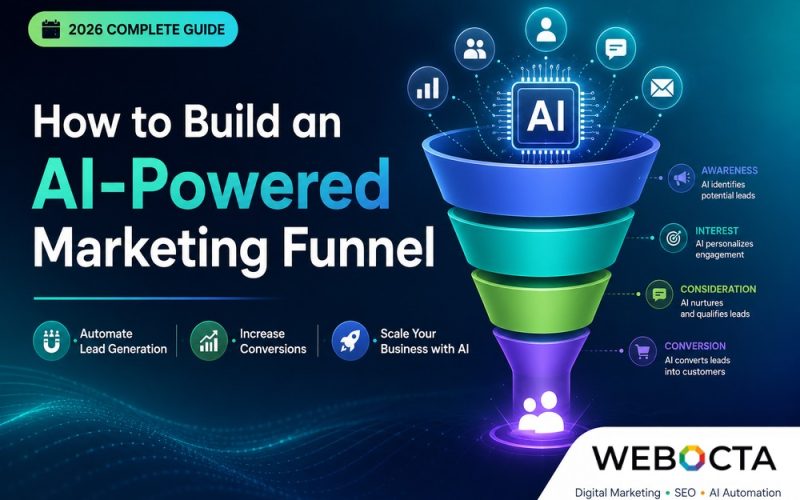
How to Build an AI-Powered Marketing Funnel to automate lead generation, increase conversions, and scale business growth with AI.

How to Build an AI-Powered Marketing Funnel: The Complete Guide to Automating Lead Generation & Sales in 2026

Artificial Intelligence (AI) has transformed how businesses attract, engage, and convert customers. Instead of relying on manual marketing tasks, companies are now using AI-powered marketing funnels to automate lead generation, personalize customer experiences, improve conversion rates, and increase ROI.

Whether you’re a startup, an established business, or a digital marketing agency, implementing an AI marketing funnel can streamline your marketing operations while delivering better customer experiences.

In this comprehensive guide, you’ll learn how to build an AI-powered marketing funnel from scratch, discover the best AI marketing tools, and explore proven strategies to generate more qualified leads and sales.

What Is an AI-Powered Marketing Funnel?

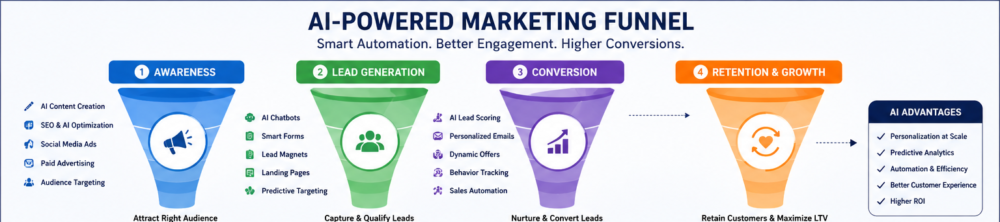
AI-powered marketing funnel showing awareness, lead generation, conversion, and retention stages

An AI-powered marketing funnel is a customer acquisition system that uses Artificial Intelligence, machine learning, predictive analytics, and marketing automation to guide potential customers from awareness to purchase—and beyond.

Unlike traditional marketing funnels that require manual intervention, AI automates repetitive tasks such as:

  • Customer segmentation
  • Lead scoring
  • Email automation
  • Personalized recommendations
  • AI chatbot conversations
  • Sales forecasting
  • Customer journey optimization

The result is a smarter, faster, and more efficient AI sales funnel that improves customer engagement while reducing marketing costs.

Why AI Is Changing Marketing Funnels

Today’s customers expect personalized experiences across every touchpoint. AI makes this possible by analyzing user behavior in real time and delivering relevant content, offers, and recommendations.

Key Benefits of AI Marketing Automation

  • Automates repetitive marketing tasks
  • Improves customer engagement
  • Generates better-quality leads
  • Reduces customer acquisition costs
  • Increases conversion rates
  • Provides predictive insights
  • Enhances customer personalization
  • Supports 24/7 customer interactions using AI chatbots

Businesses adopting AI marketing automation gain a competitive advantage by making faster, data-driven decisions while improving customer satisfaction.

The 5 Stages of an AI-Powered Marketing Funnel

Stage 1: Awareness

The first step is attracting potential customers.

Use AI to:

  • Generate SEO-optimized content
  • Create blog articles
  • Schedule social media posts
  • Optimize Google Ads
  • Analyze trending keywords
  • Improve content recommendations

Recommended AI Tools

  • ChatGPT
  • Gemini AI
  • Claude AI
  • Perplexity AI
  • Surfer SEO
  • Semrush AI

Content marketing, SEO, and paid advertising remain essential for building awareness, while AI enhances efficiency and scalability.

Stage 2: Interest & Lead Generation

Once visitors land on your website, the goal is capturing qualified leads.

Effective lead generation methods include:

  • AI-powered chatbots
  • Smart contact forms
  • Lead magnets
  • Interactive quizzes
  • Personalized landing pages

AI can instantly identify visitor intent and recommend relevant services or content.

For example, a visitor searching for SEO services may automatically receive a downloadable SEO checklist or consultation offer.

Stage 3: Consideration

During this stage, prospects compare your business with competitors.

AI helps by providing personalized experiences through:

  • Automated email sequences
  • Product recommendations
  • Personalized website content
  • CRM automation
  • Lead scoring
  • Customer segmentation

This improves engagement and nurtures prospects until they’re ready to buy.

Stage 4: Conversion

This is where AI maximizes sales opportunities.

AI-powered conversion strategies include:

  • Dynamic pricing
  • Personalized offers
  • AI sales assistants
  • Automated follow-ups
  • Predictive analytics
  • Smart scheduling

Businesses using AI often reduce abandoned inquiries through automated reminders and personalized communication.

Stage 5: Retention & Growth

A successful marketing funnel doesn’t end after the sale.

AI improves customer retention through:

  • Email automation
  • Loyalty campaigns
  • Customer satisfaction surveys
  • AI-powered support
  • Upselling
  • Cross-selling

Returning customers are typically more profitable than acquiring new ones, making retention a critical part of any marketing strategy.

How to Build an AI Marketing Funnel

Step 1: Define Your Ideal Customer

Understand:

  • Demographics
  • Pain points
  • Goals
  • Buying behavior
  • Preferred communication channels

AI tools can analyze historical customer data to identify high-value audiences.

Step 2: Create High-Quality Content

Publish:

  • Blogs
  • Videos
  • Case studies
  • Guides
  • Landing pages

Optimize every page for SEO while answering real customer questions.

Content should demonstrate experience, expertise, authority, and trustworthiness (EEAT).

Step 3: Capture Leads

Offer valuable resources such as:

  • Free audits
  • Templates
  • Checklists
  • Consultations
  • Industry reports

Use AI chatbots to engage visitors and answer questions instantly.

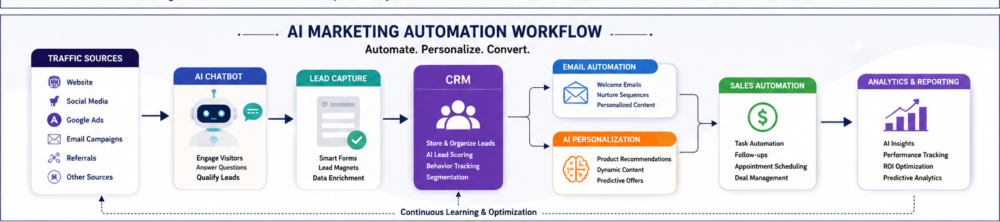
AI marketing automation workflow using CRM, chatbot, and email automation

Step 4: Automate Lead Nurturing

Build automated workflows using:

  • Email marketing
  • CRM automation
  • Lead scoring
  • Personalized content

Platforms like HubSpot AI and Salesforce AI help businesses manage prospects more efficiently.

Step 5: Analyze & Optimize

Track KPIs such as:

  • Conversion rate
  • Cost per lead
  • Customer acquisition cost
  • Return on investment
  • Bounce rate
  • Email open rate

AI identifies patterns that help improve future campaigns.

Best AI Marketing Tools in 2026

Content Creation

  • ChatGPT
  • Gemini AI
  • Claude AI

SEO

  • Surfer SEO
  • Semrush
  • Ahrefs

Marketing Automation

  • HubSpot AI
  • ActiveCampaign
  • Zapier
  • Make.com

CRM

  • HubSpot CRM
  • Salesforce AI
  • Zoho CRM

Analytics

  • Google Analytics 4
  • Looker Studio
  • Microsoft Clarity

Choosing the right combination of tools depends on your business goals, budget, and marketing maturity.

AI Marketing Funnel Example

Imagine a web design agency targeting small businesses.

  1. A prospect searches “website design company.”
  2. They discover an SEO-optimized blog.
  3. An AI chatbot offers a free website audit.
  4. The visitor submits their email.
  5. An automated email sequence shares case studies and testimonials.
  6. AI scores the lead based on engagement.
  7. A consultation is booked automatically.
  8. The sales team closes the deal.
  9. Post-sale emails encourage referrals and additional services.

This automated workflow saves time while increasing conversion rates.

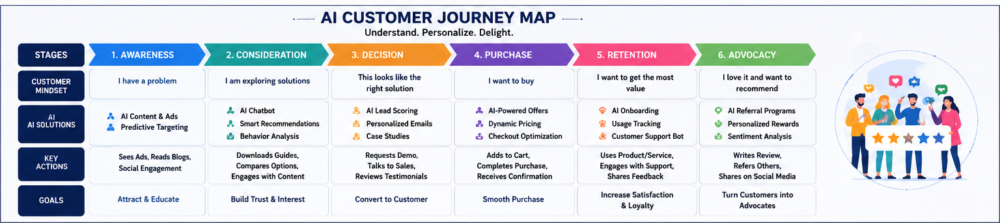
AI customer journey mapping for personalized marketing experiences

Common Mistakes to Avoid

  • Relying entirely on AI without human review
  • Ignoring customer privacy and data security
  • Publishing low-quality AI-generated content
  • Using too many disconnected tools
  • Failing to measure campaign performance
  • Neglecting SEO fundamentals
  • Not updating workflows regularly

AI should enhance human expertise—not replace it.

Future Trends in AI Marketing

Businesses should prepare for:

  • AI agents handling customer interactions
  • Predictive customer behavior modeling
  • Hyper-personalized marketing
  • Voice search optimization
  • Conversational AI
  • AI-powered video creation
  • Automated campaign optimization
  • Advanced customer journey mapping

Companies that embrace these trends will be better positioned to compete in the evolving digital landscape.

Frequently Asked Questions

Q1. What is an AI-powered marketing funnel?

An AI-powered marketing funnel uses artificial intelligence to automate customer acquisition, lead nurturing, and conversion processes.

Q2. Can AI generate leads?

Yes. AI helps identify high-intent audiences, personalize outreach, and automate lead qualification.

Q3. Which AI tools are best for marketing?

Popular options include ChatGPT, Gemini AI, Claude AI, HubSpot AI, Salesforce AI, Semrush, Ahrefs, and Zapier.

Q4. Is AI marketing suitable for small businesses?

Absolutely. Many AI tools are affordable and help small businesses automate repetitive tasks, improve customer engagement, and increase efficiency.

Q5. What is the difference between AI automation and marketing automation?

Marketing automation follows predefined rules, while AI automation learns from data, predicts outcomes, and personalizes experiences in real time.


Final Thoughts

Building an AI-powered marketing funnel is no longer optional for businesses that want to scale efficiently. By combining AI marketing automation, customer journey mapping, CRM automation, SEO, and conversion optimization, organizations can attract better leads, deliver personalized experiences, and achieve sustainable growth.

At Webocta, we help businesses implement data-driven digital marketing strategies that combine AI with proven SEO, PPC, website development, and marketing automation practices. Whether you’re looking to optimize lead generation, improve conversion rates, or build an end-to-end AI marketing funnel, our team can help you create scalable solutions tailored to your business goals.

Ready to Build an AI-Powered Marketing Funnel?

If you’re looking to automate your marketing, generate more qualified leads, and grow your business faster, Webocta can help. Our team specializes in SEO, AI-powered marketing automation, Google Ads, Meta Ads, website design, and conversion-focused digital strategies.

Contact Webocta today for a personalized consultation and discover how AI can transform your marketing performance.

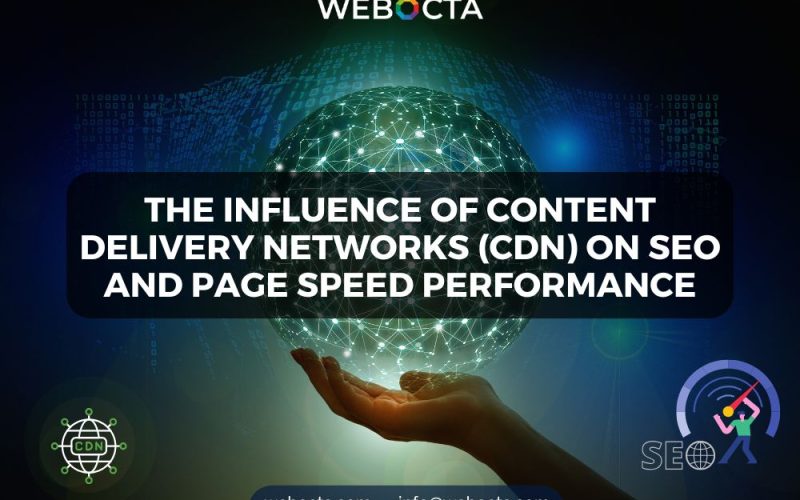
The Influence of Content Delivery Networks (CDN) on SEO and Page Speed Performance

The Influence of Content Delivery Networks (CDN) on SEO and Page Speed Performance

In the digital space, foremost activities in achieving success remains website performance. The use of Content Delivery Networks (CDN) s highly impacts website speed, which user experience, and SEO rankings. As Webocta Tech Private Limited SEO services and website optimization experts, businesses stand to gain competitive advantage.

What is a Content Delivery Network (CDN)?

A system of globally dispersed servers for hastening the delivery of website content is known as a CDN. Instead of depending solely on one server, a CDN saves cached editions of specific webpages onto numerous servers, significantly decreasing page loading time. It also improves SEO effectiveness which improves positions in search engines.

How does CDN Works?

By storing a website’s data on multiple servers that are spread across a wide geography, a CDN enhances the speed and effectiveness of the website. With this method, a user is first directed to the closest server, which results in lesser lag time as well as shortened loading periods. This also results in improved security, endurance and performance of the website.

  • Edge Server: strategically positioned near populations so they can easily retrieve and deliver cached content.
  • Load Balancing: works towards equally distributing the received traffic to minimize the chances of a single server getting too much demand.
  • Minimized Data Travel: Reducing the distance that the data needs to actually travel in order to enhance better speed.

The Role of a CDN in SEO Optimization

Search engines favor websites that load swiftly. A Content Delivery Network (CDN) influences SEO negatively or positively in a number of ways.

  • Increases Page Speed: The faster a website loads, the easier it is for users to find it, especially when making a search inquiry.
  • Boosts Core Web Vitals Performance: Google has its unique set of ranking factors that include things like: Largest Contentful Paint (LCP), First Input Delay (FID), and Cumulative Layout Shift (CLS). With a CDN, these numbers are good and maintained.
  • Lessens Server Load: A CDN avoids single server crashes and downtime by dispersing traffic among different servers.
  • Enables Better UX: When bounce rates are low due to a website being faster, engagement and conversion rates increase.
  • Increases Mobile SEO: A CDN boosts performance on mobile devices, which is necessary to ensure any rank at all.
  • Improves Security: Trust ratings of a site increase because a CDN prevents Distributed Denial of Service (DDoS) attacks.
  • Expands Reach: A CDN helps businesses grow internationally by ensuring they perform at a high level everywhere.

CDNs and Website Caching: An Overlap in Focus Areas

Website caching allows for frequent data access to provide quick page loads. A Content Delivery Network (CDN) improves store caching by utilizing:

  • Cutting down on bandwidth waste
  • Cutting Back on Time to First Byte (TTFB)
  • Rapid delivery of static assets like images, scripts, and stylesheets

Different Types of Website Caching Implemented by CDNs

  1. Browser Caching: Holds components of the website on a user’s device, enhancing retrieval time.
  2. Server Caching: Minimizes database look ups, enhancing the speed of dynamic content.
  3. Edge Caching: Retains information on the nearest CDN server for swift retrieval.

The benefits of continuity in performance leads to improved page load times and SEO rating.

Core Web Vitals, CDN and the Synergy In between:

Google’s Core Web Vitals greatly impacts SEO, which is secured by a CDN optimizing these vitals:

  • Lowering latency via remote servers
  • Boosting load rendering with efficient content caching.
  • Upholding stability by blocking any content shifts.

Dissection of Core Web Vitals:

  1. Largest Cuntentful Paint (LCP): Measures how quickly the main component of the page is displayed. A CDN can assist with this due to their available resources being readily optimized.
  2. First Input Delay (FID): Measures the time when the user tries to interact with the page. A faster server response tends to be ensured by a CDN, enabling smooth user experience.
  3. Cumulative Layout Shift (CLS): Measures loss of visual stability. A CDN mitigates unexpected layout shifts by controlling how the content is displayed.

Top tier performance and search ranking is achievable for businesses bringing in Webocta Tech Private Limited due to their expertise in CDN integration.
Extra Advantages Of A CDN

  1. Decreased Cost of Bandwidth: A CDN reduces hosting costs by caching and compressing files, which minimizes bandwidth usage.
  1. Improved Security on the Website: A CDN offers an extra layer of security against cyber attacks while protecting user data from breaches.
  1. Better Performance of Video Streaming Playback: For sites that have videos, a CDN enables smooth playback by reducing buffering and enhancing delivery speed.
  1. CNDs Scalability Configuration for High Volume Ideas: A CDN can accommodate traffic surges without any loss of efficiency so that websites remain functional even during peak periods.

CDN Integration With Webocta Tech Private Limited

Webocta Tech Private Limited is one of the top providers of digital marketing services, helping businesses integrate Content Delivery Networks (CDN) for optimal performance. The integration is important for all types of online businesses, be it an e-commerce store, an information blog, or a service-based digital platform.

How Webocta CDN Configuration Assistance Features

  • CDN Implementation and Configuration
  • Traffic Performance Analysis and Optimization
  • Important Changes Related to SEO
  • New protection against cyber threats security changes
  • Website performance problems while supporting throughout the day

Final Thoughts: CDN and Website Performance Support

This type of network is increasingly important for modern SEO as it provides a competitive edge by reducing page load times, caching, and optimizing Core Web Vitals. Implementing a Content Delivery Network (CDN) is by far the best option.

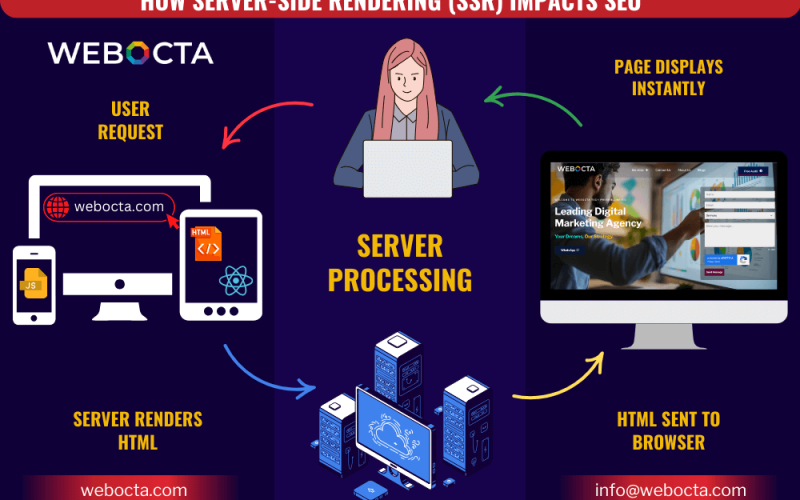
How Server-Side Rendering (SSR) Impacts SEO

How Server-Side Rendering (SSR) Impacts SEO

Search engines optimization is key in the context of digital marketing. One of the most potent means of optimizing SEO is by using Server-Side Rendering (SSR). It improves website’s speed, leading to better indexing and visibility. But how does SSR create these changes for SEO? Let’s break this down.

What is Server-Side Rendering (SSR)?

Server-Side Rendering, or SSR, is a procedure in which a website’s html is created from the server and then delivered to the browser. Unlike Client-Side Rendering (CSR), where the browser gets content compiled via JavaScript, SSR enables search engines to efficiently crawl and index websites. This translates to better search results and more visitors to the site without paid advertisements.

How SSR Benefits SEO

1. Faster Page Load Speed

Web pages that load faster are more prioritized by search engines. With SSR, rendering becomes one step quicker and ensures the website loads instantly. Any time saved is worth an increased gain in SEO rank as well as improved user experience. Studies show that websites loading within 2 seconds experience lower bounce rates and higher conversions.

2. Better Indexing by Search Engines

Bots on Google are known to have a tough time working with JavaScript-heavy pages. SSR fully renders html pages which can be indexed without a hassle by most search engines. This ensures higher rankings and better visibility for Webocta Tech Private Limited clients. Proper indexing improves content discoverability, driving more traffic to the website.

3. Improved User User Experience

A proper website structure ensures that users engage with the site and are more likely to convert. When users come across content that is relevant to them, they are likely to stay for a longer period. This in turn improves engagement while reducing bounce which in turn has a positive effect on SEO. Users spend a great deal of time on SSR websites which leads to them being more likely to visit the website again.

4. Improved Mobile Optimization

The mobile phone is immeasurably used to scour the web. Websites are ranked according to their performance on different devices because SSR guarantees a positive user experience on all of them. With Google’s increased adoption of mobile first indexing, speed and responsiveness of the website is crucial, thus, SSR cannot be overlooked Mobile users dominate the web world and SSR helps in delivering a great mobile experience.

5. Improved Engagement with Social Media

Users get an enhanced experience and better engagement which in turns increases traffic and helps SEO. More traffic does lead to better ranking, despite the fact that social signals do not directly impact the ranking. SSR ensures that the links contain accurate preview when shared which helps with social marketing campaigns.

6. Reduced Bounce Rates

More and more users tend to abandon a website if it is slow which causes high bounce rates and poor SEO. With page already rendered SSR guarantees greater engagement and lowers abandonment. Greater engagement and lower abandonment increases valuable content signals to search engines resulting in improved rank.

7. Improved Efficiency in Crawling

To crawl pages, Googlebot has to spend precious resources. Fully rendered HTML helps save crawl budget which SSR. This ensures important content gets indexed efficiently.

Difficulties of SSR When It Comes to SEO

Even if SSR is helpful to SEO, there are issues to consider:

1. Server Resources Needed To Be Increased: Since pages need to be rendered by the server, the hosting environment needs to be optimal. If there is not enough resources, performance may suffer.

2. Software Design: SSR is complex, so developers should be good at it. The system needs to be set up properly, or rendering can fail.

3. Prevention Strategies: Given the absence of reasonable caching plans, response times can be delayed. The type of edge caching improves system performance.

Ways or Approaches To Optimize SEO Results With SSR

To make SSR work to your advantage for SEO, consider the following instructions:

1. Optimize How The Server Operates: Make sure to check if the server responds quickly and is ready to accept requests. Employ CDN’s to improve top copy circulation.

2.  Implement A Mixed Strategy: Do not rely on either SSR and CSR. Some of the content can be client-side rendered to increase efficiency.

3. Optimized Caching: Some pages can be retained in pre-rendered form and not rendered every time. Add layers of caches to direct the server to not repeat renders.

4. Changing Search Google Metrics And Monitoring Systems: Utilize Google PageSpeed Insights to keep track of changes. Changes can be made on a set schedule to maintain effectiveness.

5. Optimized Open Graph And Search Engine Meta Tags: Using tags indicates how a page can be indexed and ranked. Structure Tags, Title Tags, Description Tags and Open Graph Markup Tag are well-optimized.

6. Employ Lazy Loading: This assists in managing the allocation of resources and enhances the page’s performance and usability.

7. Add Schema Markup: Structured data enhances the capability of search engines to comprehend the page better which further improves the rich snippets.

Why do you need Webocta Tech Private Limited for SEO Optimization?

Webocta offers comprehensive solutions such as SEO, digital marketing, website designing, and content writing. Our professionals have aided us in improving website visibility using advanced SSR strategies. Our numerous SEO methods enable companies to achieve a high ranking, increase site traffic, and improve sales.

Our Services Include:

Custom website development and optimization: Websites engineered from the ground up with an easy to navigate and index structure.

1. New Generation SEO Methods: Webpage content, social media pages, and entire website marketing.

2. Content Writing: Elegant, engaging, keyword-optimized content to increase website traffic.

3. Social Networks Marketing: Enhanced visibility and traffic to your site through social networks.

4. Monitoring: Instant metrics to analyze website performance and SEO parameters.

Conclusion

Server Side Rendering (SSR) improves SEO performance as it optimizes the time it takes for a page to load, improves how pages are indexed, and the experience a user receives. Additionally, businesses that adopt SSR stay on top of search rankings. Brands attract more customers by improving the company’s online presence and maximizing their reach with our help at Webocta Tech Private Limited.

Want to improve your website’s visibility? Get in touch with our experts today!

CONTACT NOW

Webocta Tech Clutch Recognition

Webocta Tech Private Limited Earns Top SEO Company for Utilities 2025 Award from Clutch

Webocta Tech Private Limited feels excited to share its new award. Clutch has named it a Top SEO Company for Utilities 2025! This honor shows Webocta Tech Private Limited strong focus on giving great digital marketing services and new SEO answers to clients in the utilities field.

About the Clutch Award

One prominent B2B rating and review website is Clutch. It examines leading service providers across numerous industries. Clutch looks at factors including customer feedback regarding a company’s level of expertise and the amount of work they have completed to select winners. Webocta Tech Private Limited is now one of the best SEO service providers in Utilities for this performance.

This recognition fills us with pride. This indicates how our wonderful staff works. To help customers achieve their Internet marketing, they are continuously and up.

Why This Award Is Important

This means that in 2025 it is much for us to be recognized by the clutch as a top Utilities SEO business. Utility companies have unique challenges for visibility and commitment online. These businesses have been thanks to our SEO strategies from enlarged organic traffic, better ranking of search engines, and long-term user engagement.

This award shows we can:

  • Create SEO plans for utility companies based on data.
  • Boost how easy websites are to find, how many people visit them, and how often visitors become customers.
  • Give ongoing SEO help to keep our clients ahead of their rivals.
  • Show clear results that help our clients grow.

A Big Thanks to Our Clients and Clutch

We want to say thanks to our amazing clients who’ve put their trust in us to handle their online marketing. Your success stories and feedback have been key to this win. Clutch deserves special thanks for this award and for giving our clients a forum to share their experiences working with us.

Looking forward to a bright future

Our inspiration to develop and provide top notes to the utility industry and other sectors is to develop and offer digital marketing services.

As the online world changes, we stay dedicated to leading the way in new ideas and excellence.

Team Up with Webocta Tech Private Limited

If you work in the utilities sector and want to boost your online visibility, we’re ready to lend a hand. To know this, contact us today about how our award-winning SEO services can promote your digital development.

We would like to thank the clutch and our valuable customers again for this wonderful honor. Here is more winning and full of great moments!

SEO for Web3 Preparing Your Website for the Future of the Internet

SEO for Web3: Preparing Your Website for the Future of the Internet

In a world where digital trends are changing constantly, SEO still holds significance as one of the most valuable strategies for business growth. Companies need to start thinking about how to prepare their websites for the future expansion of the internet with the advent of Web3. We at Webocta Tech Private Limited know how important it is to keep our clients ahead of trends. Below, we discuss ways through which you can optimize your site for Web3, sustaining the weight of your digital presence.

What is Web3 and Its Effect on SEO?

Web3 puts a spotlight on blockchain technology and improved user experience. The third form of the internet is focused on decentralization, which puts control, ownership, and data privacy on the forefront. Unlike the more traditional systems, Web3 promotes transparency and direct interactions between users. As trends shift, so should your SEO strategies to ensure your presence is highly competitive.

Important Web3 SEO techniques:

1. Optimization for Blockchain Domains

The emergence of domains such as .crypto or .eth is more aligned with the Web3 folk who are active users. To increase your relevancy, consider utilizing marketing on low-competition extension domains. These domain types are gaining traction thanks to blockchain technology.

2. Enhanced Content Management for Better Visibility

Users wanting high-quality content are at the center of Web3, and that is why it is more crucial than ever to provide relevant content. We, at Webocta, help clients with our content marketing services that help businesses create content that is engaging and ranks on search engines.

3. Incorporate AI and Machine Learning in SEO

AI tools are important in understanding how a user interacts with your content and predicting trends. You can integrate SEO tools powered by AI to give you actionable insights to improve your marketing strategies.

4.Focus on Data Privacy and Security

Privacy is a big deal in Web3. Thus, ensure your website implements data protection with secure protocols and clear data policies. Search engines reward websites that ensure a secure browsing experience.

5. Utilize Decentralized Search Engines

Decentralized search engines are the next best thing. They are gaining popularity in the domain of Web3. These platforms are fueling the growth of the decentralized web, and hence, optimizing for them can further increase your reach online as well.

How Webocta Can Help You Stay Future-Ready

At Webocta Tech Private Limited, we offer a comprehensive range of digital marketing services, including SEO, website design and development, and content marketing, to help you adapt to the changing internet landscape. Our team understands the challenges and opportunities of Web3 and works tirelessly to implement cutting-edge strategies that position your brand for success.

We believe in creating tailored solutions for each client, ensuring that your website stands out amidst the competition. Whether it’s local SEO, SEO audits, or social media management, we have you covered.

Staying Ahead with SEO for Web3

Adapting to Web3 is not just a choice—it’s a necessity. By following these strategies and partnering with experts like Webocta Tech Private Limited, your business can remain competitive and grow in this evolving digital landscape. Don’t let your website fall behind; take proactive steps today.

Get in touch with us to learn more about our comprehensive digital marketing and SEO services and how we can help your brand thrive in the Web3 era.

How to Enhance Your SEO Strategy with E-E-A-T Principles

How to Enhance Your SEO Strategy with E-E-A-T Principles

In the world of digital marketing, mastering SEO is crucial. Webocta Tech Private Limited has refined strategies that include the essential E-E-A-T principles: Expertise, Authoritativeness, and Trustworthiness. Applying these principles can significantly boost your SEO performance and help your business grow.

Understanding E-E-A-T

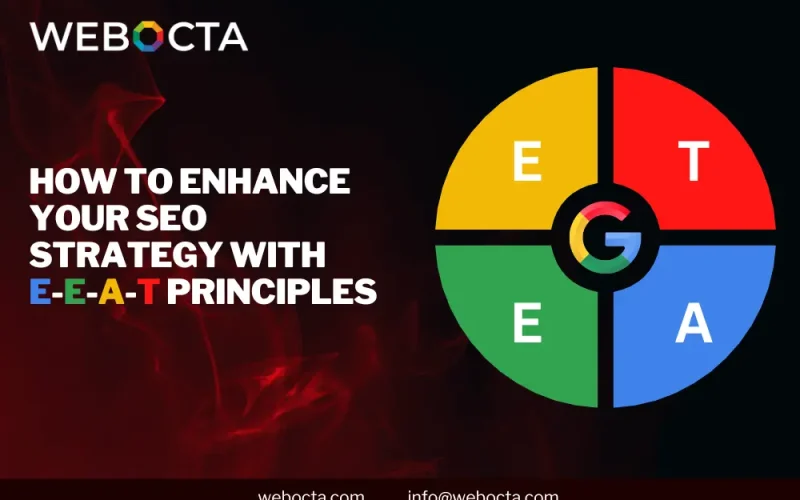
E-E-A-T stands for Expertise, Authoritativeness, and Trustworthiness. These are vital for enhancing your SEO strategy. Here’s a breakdown of each component:

  1. Expertise: Showcase your knowledge. Your content should reflect a deep understanding of the subject. Ensure your team or contributors have credible qualifications.
  2. Authoritativeness: Establish your website as an authority in your niche. This can be achieved through backlinks from reputable sites and mentions by industry experts.
  3. Trustworthiness: Build trust with your audience. Display clear contact information, have a robust privacy policy, and earn positive reviews.

How E-E-A-T Boosts Your SEO

Implementing E-E-A-T can enhance your SEO by improving your website’s credibility and user experience. Webocta Tech Private Limited emphasizes these principles to help clients achieve higher rankings on search engines.

Steps to Integrate E-E-A-T into Your SEO Strategy

1. Create High-Quality Content

Quality content is the backbone of a successful SEO strategy. Ensure your content is informative, well-researched, and valuable to your audience. Incorporate keywords like SEO, Local SEO, and digital marketing naturally within the content. At Webocta, we prioritize creating content that aligns with E-E-A-T standards.

2. Build Authoritative Backlinks

Backlinks from credible sources boost your site’s authority. Engage with industry leaders and encourage them to link back to your site. This not only enhances your SEO but also increases your site’s visibility.

3. Enhance User Experience

A user-friendly website improves trustworthiness. Ensure your site is easy to navigate, mobile-friendly, and secure. Webocta focuses on creating websites that offer an excellent user experience, which is key for Local SEO success.

4. Leverage Social Proof

Positive reviews and testimonials enhance trust. Encourage satisfied customers to leave reviews on platforms like Google My Business. Highlight these reviews on your website to build credibility.

5. Optimize for Local SEO

For businesses targeting local markets, Local SEO is essential. Optimize your website with local keywords, claim your business listings, and ensure your contact information is consistent across all platforms. Webocta Tech Private Limited specializes in local SEO, helping businesses dominate their local search results.

Implementing E-E-A-T with Webocta

Webocta Tech Private Limited is dedicated to helping businesses implement E-E-A-T principles effectively. Our comprehensive digital marketing services, including SEO, Local SEO, and content marketing, are designed to enhance your online presence and drive growth.

Continuous Improvement

SEO is not a one-time effort. Regularly update your content, monitor your backlinks, and adapt to changing algorithms. At Webocta, we stay ahead of the curve, ensuring your SEO strategy evolves with industry trends.


By integrating E-E-A-T principles into your SEO strategy, you can significantly improve your website’s performance and achieve your business goals. Webocta Tech Private Limited is here to guide you every step of the way, leveraging our expertise in digital marketing to help your business succeed.

For more insights on SEO and digital marketing, visit Webocta.