

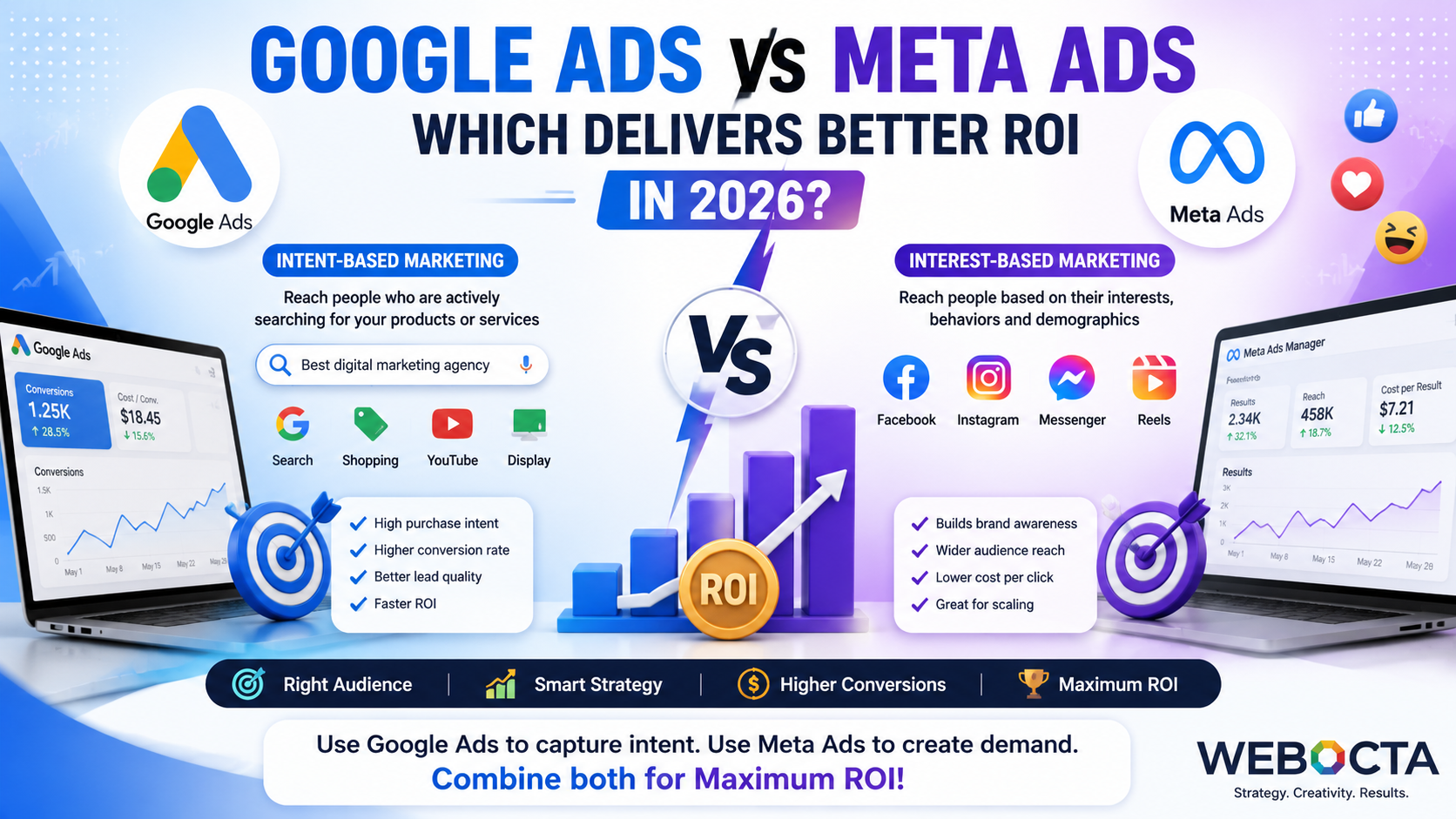
If you’re planning to invest in paid advertising, one of the biggest questions you’ll face is Google Ads vs Meta Ads: Which delivers better ROI? The answer isn’t as simple as choosing one platform over the other. Your return on investment depends on your business goals, target audience, industry, budget, and the stage of the customer journey you’re trying to influence.
Both Google Ads and Meta Ads have evolved significantly in 2026, introducing advanced AI-powered optimization, automated bidding, smarter audience targeting, and machine learning capabilities. While Google Ads captures users with high purchase intent through search, Meta Ads excel at creating demand, building brand awareness, and driving engagement across Facebook, Instagram, Messenger, and Audience Network.
After managing campaigns across multiple industries—including e-commerce, SaaS, healthcare, education, manufacturing, and service-based businesses—one insight remains consistent: the highest ROI comes from using the right platform for the right objective, not simply choosing the most popular one.
In this comprehensive guide, you’ll learn how each platform works, where each performs best, and how to maximize your advertising budget for measurable business growth.
What is Google Ads?
Google Ads is Google’s online advertising platform that enables businesses to display advertisements across:
- Google Search
- Google Shopping
- YouTube
- Gmail
- Google Display Network
- Google Discover
- Google Maps
- Partner Websites
Unlike traditional advertising, Google Ads reaches users who are actively searching for a product or service.
For example: Someone searches
“Best Digital Marketing Agency in Kolkata“
or
“Buy Running Shoes Online“
These users already have purchase intent.
This is known as Intent-Based Marketing.
Because users are already looking for solutions, Google Ads often delivers:
- Higher conversion rates
- Better lead quality
- Faster sales
- Stronger ROI for service businesses
Types of Google Ads Campaigns
Google offers multiple campaign types:
Search Campaigns
Appear directly in Google Search Results.
Best for:
- Lawyers
- Doctors
- Real Estate
- Agencies
- SaaS
- Local Businesses
Performance Max
Uses Google’s AI to automatically optimize ads across all Google properties.
Best for:
- Ecommerce
- Retail
- Lead Generation
- Multi-channel marketing
Shopping Ads
Perfect for ecommerce businesses selling physical products.
Display Ads
Banner advertisements appearing on millions of websites.
Ideal for:
- Brand Awareness
- Remarketing
- Product Launches
YouTube Ads
Video advertisements shown before or during YouTube videos.
Excellent for:
- Brand Building
- Product Demonstrations
- Educational Content
What is Meta Ads?
Meta Ads is Meta’s advertising platform that allows businesses to advertise across:
- Messenger
- Audience Network
- Reels
- Stories
Unlike Google, Meta focuses on Interest-Based Marketing.
Instead of waiting for users to search, Meta helps businesses discover potential customers based on their interests, online behaviors, demographics, and engagement patterns.
For example,
Someone may not search for
“Running Shoes”
But Meta knows they:
- Follow fitness pages
- Watch marathon videos
- Purchase sports products
- Engage with workout content
Meta will proactively display relevant ads before users even realize they need the product.
This demand-generation capability makes Meta one of the most effective platforms for awareness and consideration campaigns.
Types of Meta Ads
Meta offers multiple campaign objectives:
Awareness Campaigns
Increase brand visibility among new audiences.
Traffic Campaigns
Drive visitors to websites or landing pages.
Engagement Campaigns
Increase likes, comments, shares, and post interactions.
Lead Generation Campaigns
Capture customer information directly within Facebook or Instagram using instant forms.
Sales Campaigns
Optimize for:
- Purchases
- Add to Cart
- Checkout
- Conversions
App Promotion
Designed specifically for mobile application installs.
Google Ads vs Meta Ads: The Core Difference
Although both platforms help businesses acquire customers, they approach advertising in fundamentally different ways.
| Feature | Google Ads | Meta Ads |
| User Intent | High | Medium |
| Marketing Type | Intent-Based | Intent-Based |
| Customer Journey | Bottom Funnel | Top & Middle Funnel |
| Purchase Readiness | Very High | Medium |
| Best For | Leads & Sales | Brand Awareness & Demand Generation |
| Search Required | Yes | No |
| AI Optimization | Excellent | Excellent |
Think of it this way:
Google Ads
A customer says:
“I need this product right now.”
Google simply connects the customer with the best solution.
Meta Ads
Meta tells users:
“You might like this product.”
The platform creates interest before the customer actively searches.
Understanding User Intent
One of the biggest factors influencing ROI is user intent.
Imagine two people.
Person A
Searches:
“Emergency plumber near me”
This person needs immediate help.
They’re highly likely to convert.
Google Ads performs exceptionally well in this scenario because it captures users at the moment of need.
Person B
Is casually browsing Instagram.
They see an ad for a smart home device.
They weren’t planning to buy it, but the creative catches their attention.
They click, explore, and eventually make a purchase.
This is where Meta Ads shines—by creating demand through compelling visuals and precise audience targeting.
Why Intent Matters for ROI
Higher intent often means:
- Higher conversion rates
- Lower customer acquisition costs
- Faster sales cycles
- Better lead quality
However, businesses that rely on visual storytelling, impulse purchases, or brand discovery can achieve exceptional ROI with Meta Ads, especially when paired with effective retargeting.
Audience Targeting: Google Ads vs Meta Ads
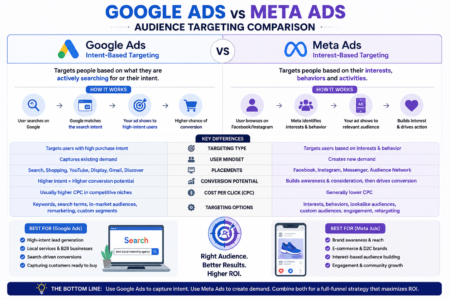
One of the biggest differences between Google Ads and Meta Ads is how each platform identifies and reaches potential customers. While both offer advanced AI-powered targeting, they rely on different signals to find the right audience.
Google Ads Targeting
Google Ads primarily targets users based on search intent. It analyzes what people are actively looking for and displays ads when their queries match your keywords or audience settings.
Targeting options include:
- Keyword Targeting
- Location Targeting
- Device Targeting
- Demographic Targeting
- In-Market Audiences
- Custom Segments
- Remarketing Lists
- Customer Match
- Performance Max AI Audience Signals
Best for:
- Local businesses
- B2B companies
- Service providers
- High-intent lead generation
- Emergency services
Meta Ads Targeting
Meta Ads focus on discovering potential customers based on interests, online behavior, and engagement across Meta’s ecosystem.
Targeting options include:
- Interest-Based Audiences
- Behavioral Targeting
- Custom Audiences
- Lookalike Audiences
- Website Retargeting
- Video View Audiences
- Instagram Engagement Audiences
- Facebook Page Engagement
- Advantage+ Audience
Best for:
- E-commerce brands
- Fashion
- Beauty
- Fitness
- Lifestyle products
- Mobile apps
- D2C businesses
Expert Insight: While Google Ads captures existing demand, Meta Ads excel at creating new demand by introducing products to users who may not yet be searching for them.
Google Ads vs Meta Ads: Cost Comparison
Advertising costs vary by industry, competition, audience, and campaign quality. Understanding these differences can help you allocate your budget more effectively.
| Metric | Google Ads | Meta Ads |
| Average CPC | Higher | Lower |
| Average CPM | Moderate | Lower |
| Lead Quality | Very High | High |
| Purchase Intent | High | Medium |
| Brand Awareness | Good | Excellent |
| Remarketing | Excellent | Excellent |
When Google Ads Costs More
Highly competitive industries such as legal services, insurance, finance, healthcare, and software often experience higher Cost Per Click (CPC) because many advertisers compete for the same high-value keywords.
However, these clicks often produce stronger leads because users already have purchase intent.
When Meta Ads Are More Cost-Effective
Meta Ads generally provide lower costs for:
- Brand awareness
- Engagement
- Video views
- Social interaction
- Product discovery
Businesses looking to build a large audience or introduce new products often benefit from Meta’s lower advertising costs.
ROI Comparison: Which Platform Performs Better?
The answer depends on your business goals rather than the platform itself.
Choose Google Ads If Your Goal Is:
✔ Lead Generation
✔ High-intent customers
✔ Local services
✔ Emergency services
✔ B2B marketing
✔ SaaS
✔ Healthcare
✔ Legal services
✔ Education
✔ Home services
Why?
People searching on Google are actively looking for a solution. This often leads to:
- Higher conversion rates
- Better lead quality
- Faster purchasing decisions
- Strong Return on Investment (ROI)
Choose Meta Ads If Your Goal Is:
✔ Brand Awareness
✔ E-commerce
✔ Fashion
✔ Beauty
✔ Consumer products
✔ Product launches
✔ Community building
✔ App installs
✔ Influencer campaigns
Why?
Meta excels at visual storytelling and audience discovery. Creative images, videos, and Reels can inspire purchases even before customers begin searching.
Google Ads vs Meta Ads for Different Industries
| Industry | Recommended Platform |
| Digital Marketing Agency | Google Ads |
| Real Estate | Google Ads |
| Law Firms | Google Ads |
| Hospitals & Clinics | Google Ads |
| Local Businesses | Google Ads |
| SaaS | Google Ads |
| Manufacturing | Google Ads |
| E-commerce | Google Ads + Meta Ads |
| Fashion | Meta Ads |
| Beauty & Cosmetics | Meta Ads |
| Restaurants | Google Ads + Meta Ads |
| Fitness Brands | Meta Ads |
| Educational Institutes | Google Ads + Meta Ads |
Should You Use Both Platforms Together?
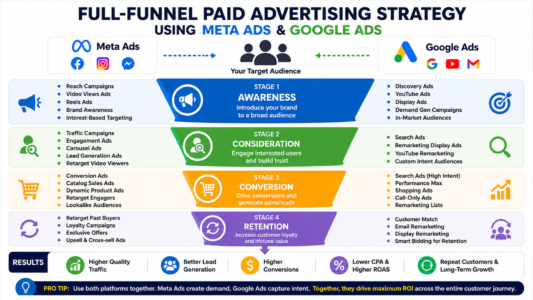
In many cases, the strongest marketing strategy is not choosing one platform over the other—it’s combining them to guide customers through the entire buying journey.
Example Funnel
Stage 1 – Awareness
Use Meta Ads to introduce your brand with engaging videos, Reels, or carousel ads.
↓
Stage 2 – Consideration
Retarget interested users with testimonials, product benefits, or educational content.
↓
Stage 3 – Conversion
Capture high-intent searches using Google Ads when prospects actively look for your product or service.
↓
Stage 4 – Retention
Use remarketing campaigns on both platforms to encourage repeat purchases and customer loyalty.
This full-funnel approach often delivers stronger long-term ROI than relying on a single advertising channel.
Pros and Cons
Google Ads
Pros
- Captures high-intent searches
- Excellent for lead generation
- Fast conversion potential
- Strong local targeting
- Effective for B2B marketing
- Robust analytics and conversion tracking
- Extensive ad placements across Google properties
Cons
- Higher CPC in competitive industries
- Requires keyword research
- Learning curve for campaign optimization
- Limited ability to generate demand for unknown products
Meta Ads
Pros
- Outstanding audience targeting
- Lower advertising costs for awareness campaigns
- Strong visual advertising formats
- Excellent for brand building
- Powerful retargeting options
- Effective for impulse purchases
Cons
- Lower purchase intent compared to search advertising
- Creative fatigue can reduce performance over time
- Frequent testing is required to maintain results
- Privacy changes may affect audience tracking
Expert Recommendations
Based on years of managing campaigns across multiple industries, here are practical recommendations:
- Local service businesses (plumbers, dentists, agencies, consultants) should prioritize Google Ads to capture users actively seeking solutions.
- E-commerce brands should combine Meta Ads for product discovery with Google Ads for branded and shopping searches.
- Startups can use Meta Ads to build awareness while gradually adding Google Ads as search demand grows.
- B2B companies often achieve better lead quality through Google Search campaigns supported by LinkedIn or Meta remarketing.
- Established brands typically benefit from a balanced strategy that leverages both platforms throughout the customer journey.
Frequently Asked Questions
Q1. Which platform offers a better ROI: Google Ads or Meta Ads?
There is no universal winner. Google Ads generally delivers higher ROI for businesses targeting users with immediate purchase intent, while Meta Ads often provide better ROI for brand awareness, product discovery, and visual consumer products.
Q2. Is Google Ads more expensive than Meta Ads?
In many industries, Google Ads have a higher average CPC due to intense competition. However, the higher cost can be justified by stronger lead quality and higher conversion rates.
Q3. Are Meta Ads suitable for B2B marketing?
Yes, but they are most effective for awareness, retargeting, employer branding, and lead nurturing. Google Ads typically perform better for capturing high-intent B2B searches.
Q4. Can small businesses use both platforms?
Absolutely. Even with a modest budget, combining Meta Ads for awareness and Google Ads for conversions can produce a balanced and scalable marketing strategy.
Q5. Which platform is better for e-commerce?
For most online stores, using both platforms delivers the best results. Meta Ads help generate demand through engaging creatives, while Google Ads capture users ready to purchase through Search and Shopping campaigns.
Conclusion
When comparing Google Ads vs Meta Ads, the most important takeaway is that the right platform depends on your business objectives, audience, and sales funnel.
If your priority is capturing customers who are actively searching for your products or services, Google Ads is often the stronger choice. If your goal is to increase brand awareness, introduce new products, or engage users through compelling visuals, Meta Ads can deliver exceptional value.
For many businesses, the highest return on investment comes from integrating both platforms into a cohesive strategy—using Meta Ads to generate interest and Google Ads to convert that interest into measurable results.
Regular testing, accurate conversion tracking, high-quality landing pages, and continuous campaign optimization are essential regardless of the platform you choose. By focusing on user intent, audience relevance, and data-driven decisions, you can maximize your advertising budget and achieve sustainable growth.