

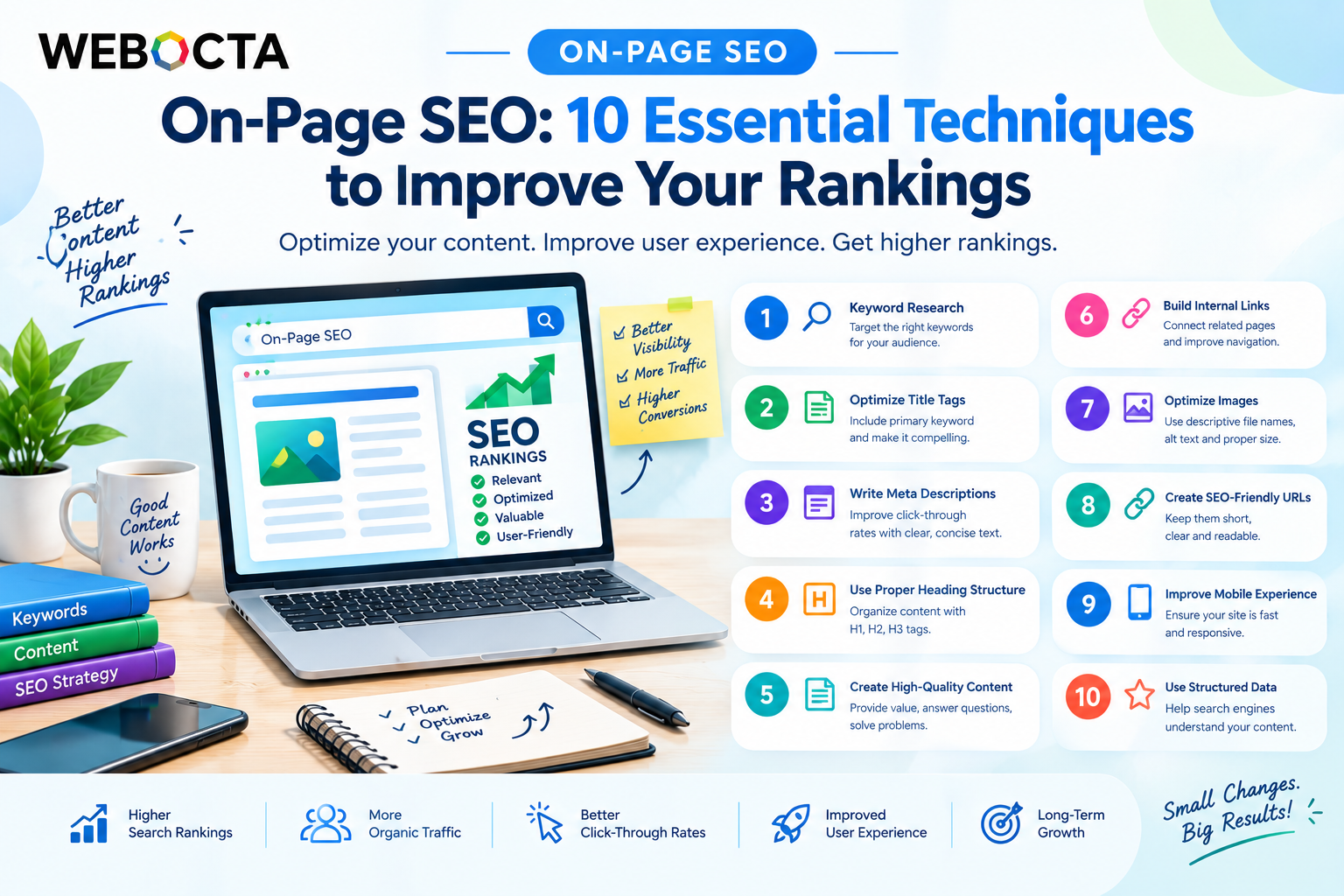
Getting your website to appear prominently in search results requires more than simply publishing content. On-Page SEO is the process of optimizing the elements on your website so search engines can better understand your pages while providing visitors with a useful and engaging experience.
From keyword placement and title tags to internal linking and mobile usability, several factors can influence how effectively a webpage performs in organic search. Here are 10 essential On-Page SEO techniques every business should consider.
1. Start With Proper Keyword Research
Keyword research is the foundation of effective On-Page SEO. Before creating content, identify the words and phrases your target audience uses when searching for your products, services, or information.
Focus on keywords that are relevant to your business and match the user’s search intent. Instead of targeting only highly competitive broad keywords, consider specific long-tail keywords that can attract more qualified visitors.
For example, a digital marketing company might target phrases such as “digital marketing services for small businesses“ rather than focusing only on “digital marketing.”
Use your primary keyword naturally throughout the page without excessive repetition.
2. Optimize Your Title Tags
The title tag is one of the most important elements of an SEO-friendly webpage. It helps search engines understand the topic of your page and often appears as the clickable headline in search results.
Create a unique, descriptive title for every important page. Include your primary keyword naturally and make the title compelling enough to encourage users to click.
For example:
On-Page SEO: 10 Essential Techniques to Improve Your Rankings
A clear title immediately tells both search engines and visitors what the page is about.
3. Write Compelling Meta Descriptions
A meta description provides a short summary of a webpage. While it is not generally considered a direct ranking factor, a well-written description can help encourage clicks from search results.
Keep your description concise, relevant, and focused on the value the user will receive. Include the primary topic or keyword naturally and give users a reason to visit your page.
Avoid creating the same meta description for multiple pages.
4. Use a Clear Heading Structure
Headings make your content easier to read and help search engines understand the organization of your page.
Use one clear H1 heading for the main topic, followed by H2 and H3 headings to organize supporting sections.
For example:
- H1: On-Page SEO Techniques
- H2: Keyword Research
- H2: Title Tag Optimization
- H2: Internal Linking
- H3: How Internal Links Help Users
A logical heading structure improves readability and makes long-form content easier to navigate.
5. Create Helpful, High-Quality Content
Content remains at the heart of successful SEO. Your pages should provide useful information that genuinely addresses the needs and questions of your target audience.
Avoid creating content simply to increase word count or insert keywords. Instead, explain concepts clearly, provide practical examples, answer common questions, and demonstrate relevant expertise.
For business websites, useful content can include guides, comparisons, tutorials, case studies, FAQs, and industry insights.
The goal should be simple: create content that users find valuable enough to read, trust, and share.
6. Build a Strong Internal Linking Strategy
Internal links connect one page of your website to another. They help visitors discover related information while helping search engines understand the relationships between pages on your site.
For example, a blog about On-Page SEO could link naturally to related pages about Technical SEO, keyword research, content marketing, and SEO services.
Use descriptive anchor text rather than generic phrases such as “click here.” A well-planned internal linking structure can also help users move through your website more easily.
7. Optimize Images
Images can make your content more engaging, but poorly optimized images can negatively affect website performance.
Use descriptive file names and appropriate alt text to help explain what an image represents. Compress images where appropriate and use suitable formats and dimensions to reduce unnecessary page weight.
For example, instead of naming an image IMG1234.jpg, use a descriptive name such as on-page-seo-techniques.jpg.
Alt text should describe the image naturally and should not be filled with unnecessary keywords.
8. Create SEO-Friendly URLs
A clean URL helps users and search engines understand what a webpage is about.
Keep URLs concise, descriptive, and relevant to the page topic. Avoid unnecessarily complicated URLs containing excessive numbers or parameters when a simpler structure is possible.
For example:
Good:
/on-page-seo-techniques/
Less useful:
/page?id=84729&category=seo
A consistent URL structure can also make your website easier to manage as it grows.
9. Improve Mobile Experience and Page Performance
A significant portion of web traffic comes from mobile devices, so your website should provide a smooth experience across different screen sizes.
Make sure pages are responsive, navigation is easy to use, text is readable, and interactive elements are accessible.
Page performance also matters. Slow-loading pages can create a poor user experience. Review factors such as image sizes, unnecessary scripts, caching, and other technical elements that may affect performance.
A fast, mobile-friendly website can help create a better overall experience for visitors.
10. Use Structured Data Where Appropriate
Structured data provides search engines with additional information about the content of a webpage. Depending on the page, structured data can describe elements such as articles, products, events, organizations, or frequently asked questions.
When implemented correctly and when eligible, structured data can help search engines better understand your content and may make pages eligible for certain enhanced search features.
However, structured data should accurately represent the visible content on your page and should follow applicable search engine guidelines.
Why On-Page SEO Matters
On-Page SEO is not about manipulating search engines. It is about making your website clearer, more useful, and easier to navigate.
When your keywords match search intent, your content answers users’ questions, your pages are well structured, and your website provides a good experience, you create a stronger foundation for organic search visibility.
It is also important to remember that On-Page SEO works together with Technical SEO and Off-Page SEO. A technically strong website with useful content and a credible online presence is better positioned for long-term organic growth.
Conclusion
Improving search rankings is an ongoing process rather than a one-time task. By implementing these 10 On-Page SEO techniques—from keyword research and title optimization to internal linking, image optimization, mobile usability, and structured data—you can create pages that are easier for search engines to understand and more valuable for your audience.
The best SEO strategy focuses on users first. Create helpful content, optimize important page elements, maintain a strong website structure, and continually improve the experience you provide. Over time, these efforts can contribute to better visibility, more qualified organic traffic, and sustainable online growth.