

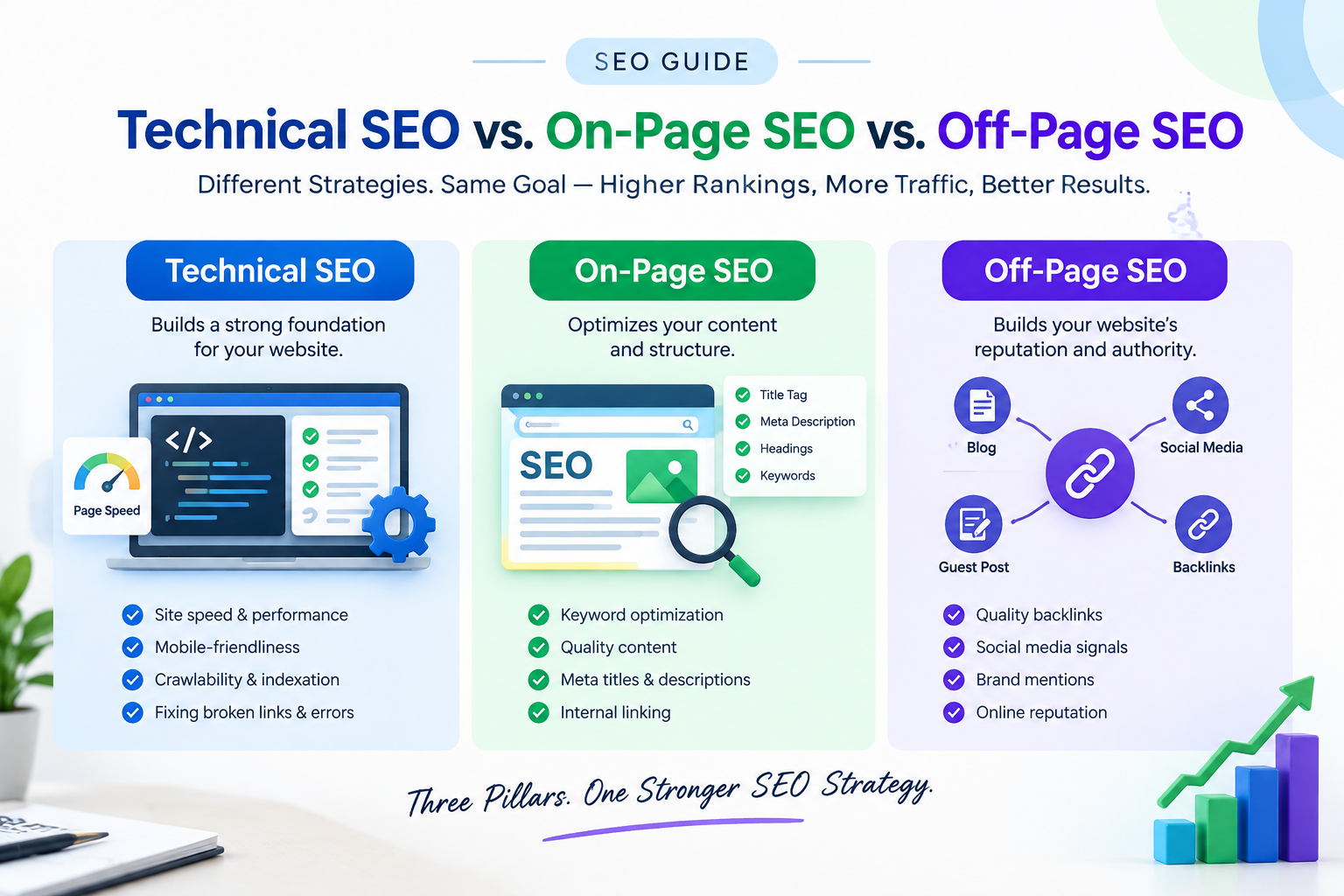
Search Engine Optimization (SEO) is one of the most important digital marketing strategies for businesses that want to improve their online visibility. However, SEO is not just about adding keywords to a website. A successful SEO strategy involves several different elements, including Technical SEO, On-Page SEO, and Off-Page SEO.
Although all three work toward the same goal—improving search engine visibility—they focus on different areas of your website and online presence. Understanding the difference can help businesses build a stronger SEO strategy and attract more relevant visitors.
What Is Technical SEO?
Technical SEO focuses on improving the technical foundation of your website so that search engines can crawl, understand, and index your pages effectively.
Technical SEO does not primarily deal with the content visitors read. Instead, it focuses on how well your website functions behind the scenes.
Important areas of Technical SEO include:
- Website loading speed and performance
- Mobile-friendliness
- Website security and HTTPS
- XML sitemap optimization
- Robots.txt configuration
- Crawlability and indexability
- Fixing broken links and errors
- Proper website architecture
- Structured data and schema markup
- Core Web Vitals
For example, if your website contains excellent content but loads very slowly on mobile devices, visitors may leave quickly. Technical improvements can create a better experience for users while also making it easier for search engines to access your website.
What Is On-Page SEO?
On-Page SEO refers to optimizing the content and elements that appear directly on your website. The purpose is to help search engines understand what each page is about while providing useful information to visitors.
Some important On-Page SEO factors include:
- Keyword research and keyword placement
- SEO-friendly title tags
- Meta descriptions
- Heading structure
- High-quality and original content
- Internal linking
- Image optimization and alt text
- URL structure
- Search intent optimization
For example, if you operate a digital marketing company and create a page targeting the keyword “digital marketing services,” the page should provide useful information about those services. The primary keyword can be naturally incorporated into the title, headings, content, URL, and other relevant areas.
However, keyword usage should always feel natural. Simply repeating a keyword multiple times does not automatically make a page better. Search engines increasingly focus on helpful, relevant content that satisfies the user’s search intent.
What Is Off-Page SEO?
Off-Page SEO involves activities performed outside your website to build its authority, credibility, and online reputation.
One of the most well-known aspects of Off-Page SEO is link building. When reputable websites link to your content, those links can contribute to your website’s authority. However, quality is generally more important than simply obtaining a large number of links.
Common Off-Page SEO activities include:
- Earning high-quality backlinks
- Digital PR
- Guest posting
- Brand mentions
- Online reputation management
- Content promotion
- Relevant business listings and citations
- Social media promotion
For example, if an industry publication references your company’s research and links to your website, it can help increase your brand’s visibility and potentially strengthen your site’s authority.
Businesses should avoid manipulative link-building practices. The goal should be to earn relevant, trustworthy references rather than collecting links simply for quantity.
Technical SEO vs. On-Page SEO vs. Off-Page SEO
The easiest way to understand the difference is to think of SEO as a three-part system.
Technical SEO builds the foundation. It ensures that your website is technically accessible, fast, secure, and easy for search engines to crawl.
On-Page SEO improves what is actually on your website. It makes your content more relevant, understandable, and useful for both search engines and visitors.
Off-Page SEO builds your website’s reputation outside your own domain. It helps establish credibility through backlinks, mentions, digital PR, and other external signals.
These three areas should not be treated as completely separate strategies. They work together.
Why Do You Need All Three?
Imagine creating an attractive website with excellent content but ignoring technical problems. Search engines may have difficulty crawling or indexing important pages.
Now imagine having a technically perfect website with poor content. Visitors may not find the information they need, and the website may struggle to satisfy search intent.
Finally, consider a technically strong website with excellent content but little online authority. It may take longer to establish visibility in competitive search results.
A balanced SEO strategy addresses all three areas.
How to Create an Effective SEO Strategy
Start by performing a technical SEO audit to identify issues affecting website performance, crawlability, mobile usability, and indexing.
Next, review your website’s content. Conduct keyword research, understand your audience’s search intent, improve titles and headings, optimize internal links, and create genuinely useful content.
Finally, develop an Off-Page SEO strategy focused on earning relevant backlinks, promoting valuable content, building brand awareness, and establishing your business as a credible source within your industry.
SEO is not a one-time activity. Search algorithms, competitors, customer behavior, and your own website will continue to change. Regular monitoring and optimization are therefore essential.
Conclusion
Technical SEO, On-Page SEO, and Off-Page SEO are three essential parts of a complete SEO strategy. Technical SEO ensures that your website has a strong foundation, On-Page SEO improves the content and structure of your pages, and Off-Page SEO helps build authority and credibility.
Instead of focusing on only one area, businesses should take a balanced approach. When technical performance, valuable content, and online authority work together, your website is better positioned to attract relevant traffic, provide a positive user experience, and support long-term digital growth.