

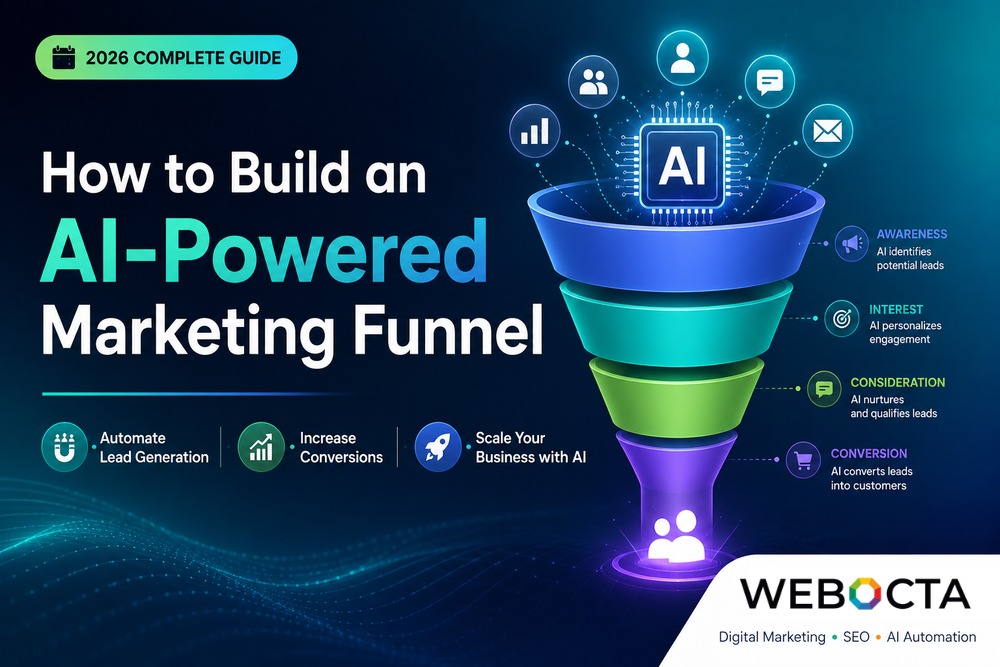
Artificial Intelligence (AI) has transformed how businesses attract, engage, and convert customers. Instead of relying on manual marketing tasks, companies are now using AI-powered marketing funnels to automate lead generation, personalize customer experiences, improve conversion rates, and increase ROI.
Whether you’re a startup, an established business, or a digital marketing agency, implementing an AI marketing funnel can streamline your marketing operations while delivering better customer experiences.
In this comprehensive guide, you’ll learn how to build an AI-powered marketing funnel from scratch, discover the best AI marketing tools, and explore proven strategies to generate more qualified leads and sales.
What Is an AI-Powered Marketing Funnel?
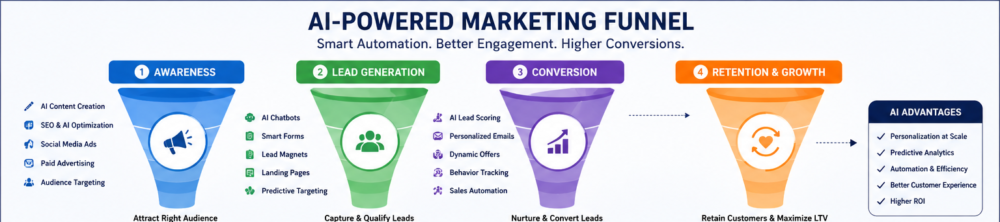
An AI-powered marketing funnel is a customer acquisition system that uses Artificial Intelligence, machine learning, predictive analytics, and marketing automation to guide potential customers from awareness to purchase—and beyond.
Unlike traditional marketing funnels that require manual intervention, AI automates repetitive tasks such as:
- Customer segmentation
- Lead scoring
- Email automation
- Personalized recommendations
- AI chatbot conversations
- Sales forecasting
- Customer journey optimization
The result is a smarter, faster, and more efficient AI sales funnel that improves customer engagement while reducing marketing costs.
Why AI Is Changing Marketing Funnels
Today’s customers expect personalized experiences across every touchpoint. AI makes this possible by analyzing user behavior in real time and delivering relevant content, offers, and recommendations.
Key Benefits of AI Marketing Automation
- Automates repetitive marketing tasks
- Improves customer engagement
- Generates better-quality leads
- Reduces customer acquisition costs
- Increases conversion rates
- Provides predictive insights
- Enhances customer personalization
- Supports 24/7 customer interactions using AI chatbots
Businesses adopting AI marketing automation gain a competitive advantage by making faster, data-driven decisions while improving customer satisfaction.
The 5 Stages of an AI-Powered Marketing Funnel
Stage 1: Awareness
The first step is attracting potential customers.
Use AI to:
- Generate SEO-optimized content
- Create blog articles
- Schedule social media posts
- Optimize Google Ads
- Analyze trending keywords
- Improve content recommendations
Recommended AI Tools
- ChatGPT
- Gemini AI
- Claude AI
- Perplexity AI
- Surfer SEO
- Semrush AI
Content marketing, SEO, and paid advertising remain essential for building awareness, while AI enhances efficiency and scalability.
Stage 2: Interest & Lead Generation
Once visitors land on your website, the goal is capturing qualified leads.
Effective lead generation methods include:
- AI-powered chatbots
- Smart contact forms
- Lead magnets
- Interactive quizzes
- Personalized landing pages
AI can instantly identify visitor intent and recommend relevant services or content.
For example, a visitor searching for SEO services may automatically receive a downloadable SEO checklist or consultation offer.
Stage 3: Consideration
During this stage, prospects compare your business with competitors.
AI helps by providing personalized experiences through:
- Automated email sequences
- Product recommendations
- Personalized website content
- CRM automation
- Lead scoring
- Customer segmentation
This improves engagement and nurtures prospects until they’re ready to buy.
Stage 4: Conversion
This is where AI maximizes sales opportunities.
AI-powered conversion strategies include:
- Dynamic pricing
- Personalized offers
- AI sales assistants
- Automated follow-ups
- Predictive analytics
- Smart scheduling
Businesses using AI often reduce abandoned inquiries through automated reminders and personalized communication.
Stage 5: Retention & Growth
A successful marketing funnel doesn’t end after the sale.
AI improves customer retention through:
- Email automation
- Loyalty campaigns
- Customer satisfaction surveys
- AI-powered support
- Upselling
- Cross-selling
Returning customers are typically more profitable than acquiring new ones, making retention a critical part of any marketing strategy.
How to Build an AI Marketing Funnel
Step 1: Define Your Ideal Customer
Understand:
- Demographics
- Pain points
- Goals
- Buying behavior
- Preferred communication channels
AI tools can analyze historical customer data to identify high-value audiences.
Step 2: Create High-Quality Content
Publish:
- Blogs
- Videos
- Case studies
- Guides
- Landing pages
Optimize every page for SEO while answering real customer questions.
Content should demonstrate experience, expertise, authority, and trustworthiness (EEAT).
Step 3: Capture Leads
Offer valuable resources such as:
- Free audits
- Templates
- Checklists
- Consultations
- Industry reports
Use AI chatbots to engage visitors and answer questions instantly.
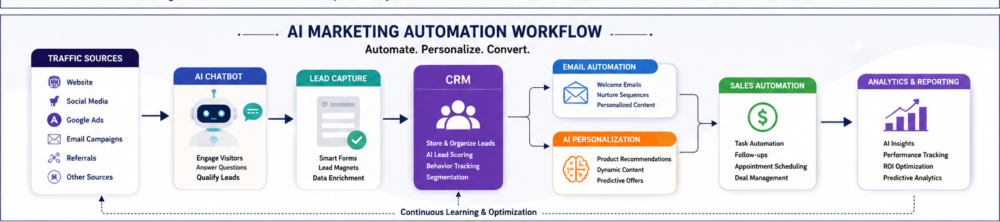
Step 4: Automate Lead Nurturing
Build automated workflows using:
- Email marketing
- CRM automation
- Lead scoring
- Personalized content
Platforms like HubSpot AI and Salesforce AI help businesses manage prospects more efficiently.
Step 5: Analyze & Optimize
Track KPIs such as:
- Conversion rate
- Cost per lead
- Customer acquisition cost
- Return on investment
- Bounce rate
- Email open rate
AI identifies patterns that help improve future campaigns.
Best AI Marketing Tools in 2026
Content Creation
- ChatGPT
- Gemini AI
- Claude AI
SEO
- Surfer SEO
- Semrush
- Ahrefs
Marketing Automation
- HubSpot AI
- ActiveCampaign
- Zapier
- Make.com
CRM
- HubSpot CRM
- Salesforce AI
- Zoho CRM
Analytics
- Google Analytics 4
- Looker Studio
- Microsoft Clarity
Choosing the right combination of tools depends on your business goals, budget, and marketing maturity.
AI Marketing Funnel Example
Imagine a web design agency targeting small businesses.
- A prospect searches “website design company.”
- They discover an SEO-optimized blog.
- An AI chatbot offers a free website audit.
- The visitor submits their email.
- An automated email sequence shares case studies and testimonials.
- AI scores the lead based on engagement.
- A consultation is booked automatically.
- The sales team closes the deal.
- Post-sale emails encourage referrals and additional services.
This automated workflow saves time while increasing conversion rates.
Common Mistakes to Avoid
- Relying entirely on AI without human review
- Ignoring customer privacy and data security
- Publishing low-quality AI-generated content
- Using too many disconnected tools
- Failing to measure campaign performance
- Neglecting SEO fundamentals
- Not updating workflows regularly
AI should enhance human expertise—not replace it.
Future Trends in AI Marketing
Businesses should prepare for:
- AI agents handling customer interactions
- Predictive customer behavior modeling
- Hyper-personalized marketing
- Voice search optimization
- Conversational AI
- AI-powered video creation
- Automated campaign optimization
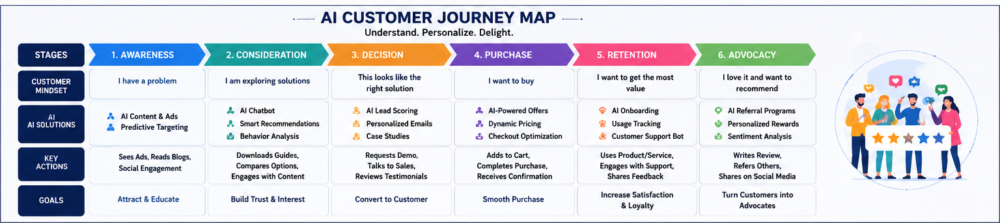
- Advanced customer journey mapping
Companies that embrace these trends will be better positioned to compete in the evolving digital landscape.
Frequently Asked Questions
Q1. What is an AI-powered marketing funnel?
An AI-powered marketing funnel uses artificial intelligence to automate customer acquisition, lead nurturing, and conversion processes.
Q2. Can AI generate leads?
Yes. AI helps identify high-intent audiences, personalize outreach, and automate lead qualification.
Q3. Which AI tools are best for marketing?
Popular options include ChatGPT, Gemini AI, Claude AI, HubSpot AI, Salesforce AI, Semrush, Ahrefs, and Zapier.
Q4. Is AI marketing suitable for small businesses?
Absolutely. Many AI tools are affordable and help small businesses automate repetitive tasks, improve customer engagement, and increase efficiency.
Q5. What is the difference between AI automation and marketing automation?
Marketing automation follows predefined rules, while AI automation learns from data, predicts outcomes, and personalizes experiences in real time.
Final Thoughts
Building an AI-powered marketing funnel is no longer optional for businesses that want to scale efficiently. By combining AI marketing automation, customer journey mapping, CRM automation, SEO, and conversion optimization, organizations can attract better leads, deliver personalized experiences, and achieve sustainable growth.
At Webocta, we help businesses implement data-driven digital marketing strategies that combine AI with proven SEO, PPC, website development, and marketing automation practices. Whether you’re looking to optimize lead generation, improve conversion rates, or build an end-to-end AI marketing funnel, our team can help you create scalable solutions tailored to your business goals.
Ready to Build an AI-Powered Marketing Funnel?
If you’re looking to automate your marketing, generate more qualified leads, and grow your business faster, Webocta can help. Our team specializes in SEO, AI-powered marketing automation, Google Ads, Meta Ads, website design, and conversion-focused digital strategies.
Contact Webocta today for a personalized consultation and discover how AI can transform your marketing performance.