

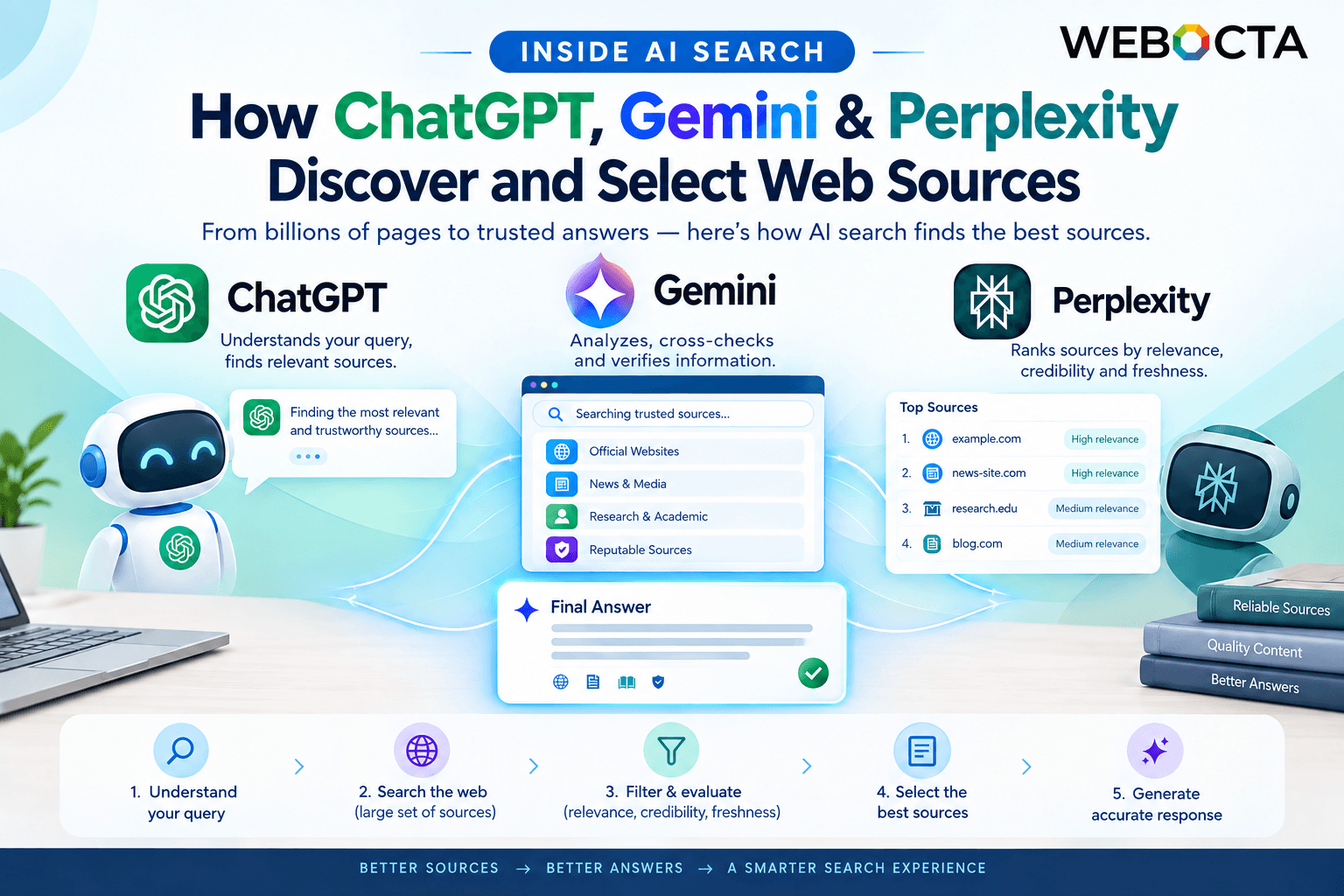
Search is changing rapidly. For years, businesses focused on ranking their websites on Google and other traditional search engines. Today, users are increasingly asking AI tools such as ChatGPT, Google Gemini, and Perplexity to research products, compare services, answer questions, and summarize information.
This creates a new question for businesses: How do AI search platforms discover and select the web sources they use in their answers?
Understanding this process can help marketers create content that is easier for AI systems to discover, understand, and potentially reference.
What Is AI Search?
AI search combines traditional information retrieval with artificial intelligence. Instead of simply presenting a list of links, AI-powered platforms can interpret a user’s question, retrieve relevant information, and generate a conversational response.
Different platforms use different technologies and workflows. Some AI experiences can search the web in real time, while others may use information from their underlying models, connected sources, or specialized retrieval systems.
This means there is no single universal “AI ranking algorithm.”
However, several common principles influence whether online information can be discovered and used.
How Does ChatGPT Discover Web Sources?
When web search is available, ChatGPT can search the internet to find information relevant to a user’s question. It may retrieve multiple webpages, evaluate the available information, and use relevant sources when generating its response.
For businesses, this means having a website that clearly explains what the company does, who it serves, and what information it provides can be important.
Content should be:
- Clear and easy to understand
- Relevant to specific user questions
- Well structured
- Factually accurate
- Supported by trustworthy information
- Regularly maintained when information changes
A page that directly answers a user’s question can be more useful than a page created primarily to repeat keywords.
How Does Google Gemini Find Information?
Google Gemini is integrated into Google’s broader ecosystem, and its search-related experiences can use information retrieved from the web.
Google’s search systems have long emphasized relevance, quality, usefulness, and technical accessibility. These principles remain important when creating content that may appear in AI-powered search experiences.
For example, a business publishing a detailed guide about local SEO should clearly explain concepts, use descriptive headings, answer common questions, and provide information that users can actually apply.
AI systems can then have clearer information to interpret when retrieving content.
How Does Perplexity Select Sources?
Perplexity is designed around an answer-focused search experience. It retrieves information from online sources and typically provides citations so users can examine where information came from.
This makes source quality particularly important.
If your website publishes original research, expert insights, statistics, case studies, or detailed educational content, those resources can potentially become useful references when an AI search system is researching a related topic.
However, appearing as a source is never guaranteed. AI systems can choose different sources depending on the user’s exact question, available information, freshness, relevance, and other factors.
What Makes a Website More Discoverable to AI Search?
Although AI platforms differ, several SEO fundamentals remain useful.
1. Create Helpful, Original Content
AI systems need information they can understand and use. Instead of producing large volumes of generic articles, focus on creating original, useful resources.
Include practical examples, explanations, statistics, case studies, and expert perspectives where appropriate.
2. Answer Specific Questions
Users increasingly ask detailed questions rather than searching for short keywords.
For example, instead of targeting only “SEO services,” create useful content around questions such as:
“How does local SEO help small businesses generate leads?”
Answer the question directly and provide supporting information throughout the article.
3. Build Topical Authority
A single article may not establish your expertise on an entire subject.
A digital marketing company, for example, could create connected content covering technical SEO, on-page SEO, local SEO, content marketing, keyword research, analytics, and AI search.
Internal links can help users and search engines understand the relationship between these topics.
4. Keep Information Accurate and Updated
AI search often deals with questions where information can change quickly.
Business details, product information, statistics, regulations, pricing, and technology developments should therefore be reviewed and updated when necessary.
Outdated information can reduce the usefulness of a page.
5. Make Your Website Easy to Understand
Technical SEO still matters.
Search engines and other systems need to access your website effectively. Make sure important pages are crawlable, mobile-friendly, reasonably fast, and logically structured.
Use descriptive page titles, headings, URLs, image alt text, and appropriate structured data where relevant.
6. Establish Trust and Credibility
Who created the content? What experience or expertise do they have? Is the information supported by reliable evidence?
Clearly identifying authors, businesses, sources, and relevant credentials can help users understand why they should trust the information.
AI Search Is Not a Replacement for SEO
One common misconception is that businesses now need to choose between SEO and AI optimization.
In reality, many of the fundamentals overlap.
High-quality content, strong technical foundations, clear website architecture, relevant topics, authoritative references, and a positive user experience remain valuable.
The difference is that marketers now need to think beyond traditional search-result rankings and consider how their content can become useful information within AI-generated answers.
How Businesses Can Prepare for AI Search
Businesses should begin by auditing their existing content.
Identify the questions your customers ask, then determine whether your website provides clear and authoritative answers. Update outdated articles, strengthen weak content, create original resources, and improve internal linking.
It is also useful to monitor how your brand appears across different AI search platforms. Because AI-generated results can vary based on the question, location, time, available sources, and other factors, a single observation should not be treated as a permanent ranking.
Conclusion
AI search is changing how people discover information online. ChatGPT, Gemini, and Perplexity can use different systems and sources, but businesses can improve their chances of being discoverable by focusing on the fundamentals: useful content, technical accessibility, clear information, topical expertise, accuracy, and credibility.
The future of search is not simply about ranking a webpage. It is increasingly about becoming a reliable source of information that search engines and AI systems can understand, retrieve, and potentially reference.
For digital marketers, this creates a broader opportunity: instead of optimizing content only for keywords, create resources that genuinely answer the questions your audience is asking.